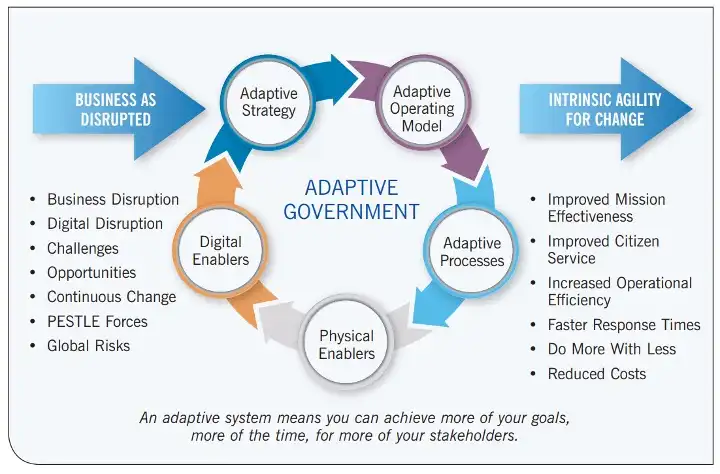
As another example, much like the US military’s defense readiness condition (DEFCON) system, the ability to quickly respond to change, and to do so with pre-defined “go-to” operating conditions, enables an organization to continuously maximize its uptime and benefit for stakeholders without having to reinvent itself every time.
An adaptability strategy can address a broad array of business goals
Adaptability can be applied to a wide array of business and strategic goals across both public and private sector organizations. If you’re a CIO for a city, for example, it can apply to your
city’s strategic goals, including economic growth, diversity and inclusion, quality of life, health and wellness, safety and security, efficiency and resilience, mobility, and sustainability and environment.
As an example, moveable systems such as the Thames Barrier support efficiency and resilience; adaptive traffic control systems (ATCS) support mobility in terms of leveraging AI, video cameras, and IoT sensors to optimize traffic flow; digital twins of buildings and stadiums support safety and security in terms of live data feeds and wayfinding for first responders; and 3D-printing solutions support quality of life in terms of affordable housing, and so on.
Adaptability is a new management discipline
Sustainability and resilience are mature management disciplines because a lot of attention has been paid to developing strategies and implementing solutions to address them. When it comes to adaptability, however, apart from agile methodologies and adaptation as it relates to climate change, there’s very little to learn from in terms of the body of work, which is why I addressed this issue in “
A Guide to Adaptive Government: Preparing for Disruption.”
Adaptive systems and resilient systems are often confused and thought of as interchangeable, but there’s a vast difference between the two concepts. Whereas an adaptive system restructures or reconfigures itself to best operate in and optimize for the ambient conditions, a resilient system often simply has to restore or maintain an existing steady state.