.png?width=185&height=175&name=WGI%20Icon_Green%20(1).png)



















By Nicholas D. Evans
As disruption in all its forms increasingly becomes the norm, IT leaders must rethink their approach to digital initiatives in favor of strategies that build adaptability into the way their organizations operate on a daily basis.
The past decade in IT has been all about digital transformation. Under the aegis of digital transformation, IT initiatives have become more customer-centric, with a greater emphasis on people, not technology — all in an effort to redefine how the organization operates and to ensure it can keep up with the pace of change, capable of dealing with challenges and taking advantage of opportunities as they arise.
The problem, however, is that many organizations have been on the transformation treadmill for years, if not a decade or more. Transformations once envisioned to be a two- or three-year journey, to catch up or get ahead, have become a continuous journey with no end in sight. They’ve simply become the price of doing business, just like issuing payroll or filing tax returns.
This is perfectly fine in theory because digital transformation should be a continuous journey and not a one-time effort. But while we’ve been on this journey over the past 10 years, the world has changed, and IT now needs a new approach — one in which adaptability becomes the underlying focus of all transformation efforts moving forward. Here’s why.
Disruption has moved from the exception to the norm
With disruption now a constant rather than one-off event, organizations must be able to quickly react to change with agility across all aspects of their operating models. It’s no longer sufficient to pursue after-the-fact transformations. We need to build in the ability to change and react to change across all aspects of our organizations’ strategy, business model, operating model, processes, products, and services. We’re also now dealing with disruption in all its forms, not just that of digital upstarts arising to eat our market share. In recent years, the scale and frequency of disruption has increased across all the so-called PESTLE forces — political, economic, societal, technological, legal, and environmental. There’s no longer a steady state “business as usual” for 364 days per year; it’s “business as disrupted” that’s the norm, so our organizations must become intrinsically agile with adaptability built into the way they operate on a daily basis.Adaptability has a compelling business case
We learned how important adaptability was during the pandemic. Instead of the binary states of “open” or “closed” (i.e., restaurants, schools, shops, offices), by having multiple modes of operation and being able to jump dynamically between them, organizations were able to balance lives and livelihoods in a more effective manner and to keep revenue flowing and services delivered.
And this goes for government organizations as well as private corporations, as adaptability enables improved mission effectiveness, improved citizen service, increased operational efficiency, faster response times, the ability to do more with less, and reduced costs. By establishing an adaptive organization, you can achieve more of your goals, for more of the time, for more of your stakeholders.
[caption id="attachment_206350" align="aligncenter" width="720"]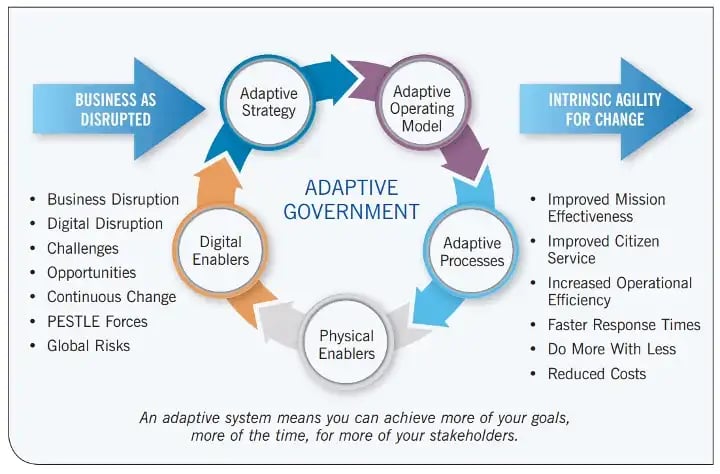 CAPTION: MISSION BENEFITS AND ROI OF ADAPTIVE GOVERNMENT CREDIT: NICHOLAS EVANS / IDG[/caption]
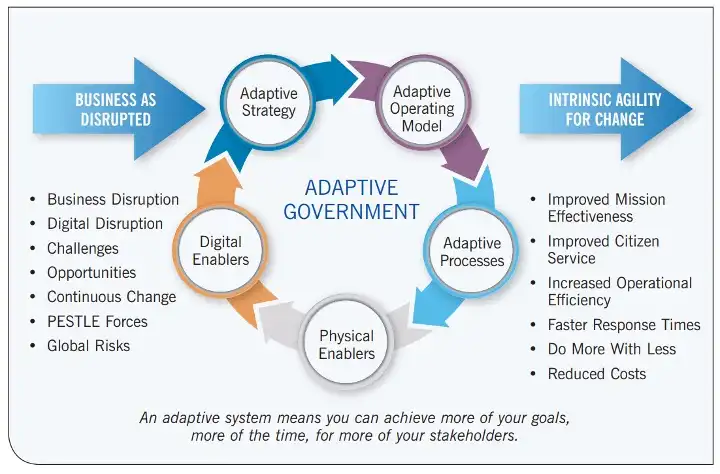 CAPTION: MISSION BENEFITS AND ROI OF ADAPTIVE GOVERNMENT CREDIT: NICHOLAS EVANS / IDG[/caption]
As another example, much like the US military’s defense readiness condition (DEFCON) system, the ability to quickly respond to change, and to do so with pre-defined “go-to” operating conditions, enables an organization to continuously maximize its uptime and benefit for stakeholders without having to reinvent itself every time.
An adaptability strategy can address a broad array of business goals
Adaptability can be applied to a wide array of business and strategic goals across both public and private sector organizations. If you’re a CIO for a city, for example, it can apply to your city’s strategic goals, including economic growth, diversity and inclusion, quality of life, health and wellness, safety and security, efficiency and resilience, mobility, and sustainability and environment. As an example, moveable systems such as the Thames Barrier support efficiency and resilience; adaptive traffic control systems (ATCS) support mobility in terms of leveraging AI, video cameras, and IoT sensors to optimize traffic flow; digital twins of buildings and stadiums support safety and security in terms of live data feeds and wayfinding for first responders; and 3D-printing solutions support quality of life in terms of affordable housing, and so on.Adaptability is a new management discipline
Sustainability and resilience are mature management disciplines because a lot of attention has been paid to developing strategies and implementing solutions to address them. When it comes to adaptability, however, apart from agile methodologies and adaptation as it relates to climate change, there’s very little to learn from in terms of the body of work, which is why I addressed this issue in “A Guide to Adaptive Government: Preparing for Disruption.” Adaptive systems and resilient systems are often confused and thought of as interchangeable, but there’s a vast difference between the two concepts. Whereas an adaptive system restructures or reconfigures itself to best operate in and optimize for the ambient conditions, a resilient system often simply has to restore or maintain an existing steady state.
In addition, whereas resilience is a risk management strategy, adaptability is both a risk management and an innovation strategy. The philosophy behind adaptive systems is more about innovation than risk management. It assumes from the start, that there are no steady state conditions to operate within, but that the external environment is constantly changing.
By digging deeper into adaptability as a management discipline, we can apply the principles of nature to better react to change and do so with intrinsic agility, much as the chameleon changes its color or how the human body physically adapts to exercise.
Physical and digital enablers make adaptability actionable
CIOs are in a prime position to help their organizations with its adaptability strategy by implementing physical and digital technologies that enable adaptability. Just as the so-called SMAC (social, mobile, analytics, and cloud) technologies ushered in the inaugural era of digital transformation, the next generation of technologies such as AI/ML, AR/VR, blockchain, digital twins, quantum computing, IoT, edge computing, and the metaverse will enable a new era of adaptability in both the enterprise and government.
For example, a city can become more adaptive in its use of “flexible spaces” by using techniques such as popup retail, programmable streets, and dynamic curb management. Strategies such as these, and the technologies that enable them, will help the city “do more with less,” such as leveraging existing “brown infrastructure” as well as becoming more adaptive to support dynamically changing needs of its stakeholders. Both physical enablers such as popup retail and digital enablers such as dynamic curb management can contribute to this increased level of adaptability.
While adaptability can’t solve for all unknowns, it can help your organization deal with a broader range of extremes and boundary conditions as part of business as usual, freeing up time and resources to focus on the real outliers which can’t be planned for.
While competitors are essentially driving a car with manual transmission and a single gear, you’ll be driving with automatic transmission and six gears or more, ready to tackle the terrain ahead. It’s time to say goodbye to digital transformation and hello to the adaptive enterprise.
To access the original article, please click here.