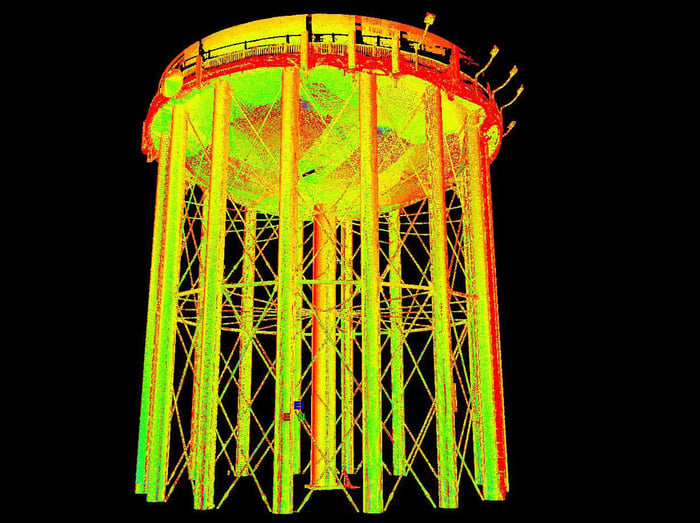
The City of Tampa desired a structural analysis of two 1.5 million gallon elevated water storage tanks constructed in the early 1940s (Palma Ceia and West Tampa). The City also requested a radiation analysis be performed for the existing communication antennas (currently mounted to the tank) to establish the maximum radiation exposure. WGI utilized Light Detection and Ranging (Lidar), the resulting Lidar point cloud data, and AutoCad recap drawing of the existing West Tampa and Palma Ceia tanks and photos. This data, coupled with conventional onsite measurements for component thickness, was utilized for the structural analysis.
Using the 3D point cloud model of the water tower structure, the structural components could be measured (both in-field and virtually) to establish the size of structural members, the access platform framing, and the size and location of the antennas. While utilizing existing documentation, the extracted point cloud information, and infield measurements, WGI developed a structural mathematical model of the tanks.
Utilizing the data, WGI performed a structural analysis of the existing tanks using the prescribed wind load per American Society of Civil Engineers {ASCE) 7, Risk Category III for the following capacity scenarios:
• Structural capacity of the tanks without antenna mounting.
• Structural capacity of the tanks with the existing antenna mounting.
• Structural capacity of the existing antennas and up to three AMI deployment configurations per tank.
Using the documents and information provided by the City, WGI and their subconsultant analyzed the radiation associated with the antennas and AMI equipment. The analysis was based upon the transmitting antennas operating at 100% capacity and 100% duty cycle to simulate a maximum worst-case emissions scenario for safety purposes. The City can utilize these reports to manage antenna leases, make or alter operational protocols, and limit or allow new antennas to be added to the tanks.
.png?width=185&height=175&name=WGI%20Icon_Green%20(1).png)