.png?width=185&height=175&name=WGI%20Icon_Green%20(1).png)















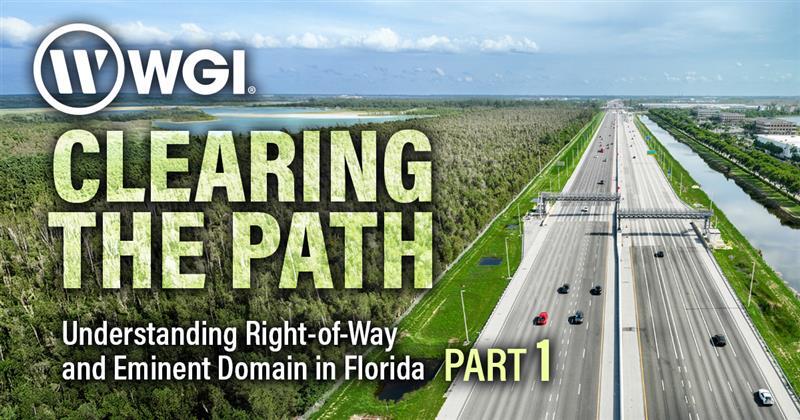
Florida’s rapid population growth and ongoing economic development demand constant improvements and expansions to public infrastructure, including roads, rail systems, utilities, greenways, and transit corridors – These critical improvements often require acquiring land that is privately owned, a process known as Right-of-Way (ROW) acquisition.
For government agencies, consultants, and property owners, understanding this process is essential to ensuring fair, legal, and efficient development.
 Acquisitions are often done voluntarily through negotiations with property owners. However, in cases where an agreement can't be reached, the government may invoke its power of eminent domain.


What is Right-of-Way Acquisition?
Right-of-Way acquisition is the process of obtaining land rights to facilitate public improvements. This may involve acquiring an entire property or just a portion of it (a partial taking). These takings must balance the public's need for infrastructure with the property owner's right to fair compensation. The process can become especially intricate when property access, functionality, or a business is impacted.
What is Eminent Domain?
Eminent domain is the constitutionally and statutorily granted power that allows governmental entities to take private property for public use, with the condition that the property owner receives "just compensation." In Florida, this process is guided by specific legal frameworks, including Chapters 73 and 74 of the Florida Statutes. Eminent domain is a last resort when negotiations fail, and it typically includes formal legal proceedings known as condemnation. While the public purpose requirement is relatively broad, encompassing transportation, utilities, flood control, and more, strict procedures exist to protect property owners and ensure fairness.The Process in a Nutshell
- Project Planning and Scoping: Agencies determine what land is needed and begin early coordination with consultants.
- Appraisal and Valuation: Independent appraisers determine the fair market value of affected properties.
- Negotiation: Agencies attempt to purchase the property at appraised value through good faith negotiations.
- Condemnation: If negotiations fail, a formal legal action is filed to acquire the property through eminent domain.
- Compensation and Relocation Assistance: Owners are compensated for the value of the land, and in some cases, for damages and relocation.

Challenges in ROW Projects
ROW and eminent domain projects are inherently complex. Property ownership may involve multiple individuals, unclear titles, or existing legal encumbrances. Environmental concerns, zoning regulations, and community opposition can add further layers of difficulty. Litigation may arise when property owners dispute the appraised value or claim that the taking has damaged the remainder of their property. Business owners may require compensation for loss of income or loss of access. Each scenario requires a strategic, sensitive, and well-informed approach.
WGI’s Role and Expertise
WGI provides end-to-end support for ROW acquisition and eminent domain projects by leveraging our multidisciplinary, in-house team – This allows for seamless coordination and consistency throughout every phase of a project. Our experts include:- Civil and Structural Engineers
- Planners and Architects
- Environmental Scientists
- Surveyors
- GIS Technicians
- Utility Coordinators
- Arborists
- Landscape Architects
- Inventory of existing site conditions
- Surveying of taking and remaining tracts
- Impact analysis (physical, regulatory, and operational)
- Zoning and land use evaluations
- Cure concept development to mitigate the adverse effects of the ROW acquisition
- Cost-to-cure evaluations and valuation support
- Planning and engineering reports and graphics
- Expert witness testimony for hearings and trials
- Preparation of trial exhibits and public outreach materials
- Planning, engineering, surveying, and landscape architecture services associated with obtaining site plan modification approval from the local municipality
