.png?width=185&height=175&name=WGI%20Icon_Green%20(1).png)


















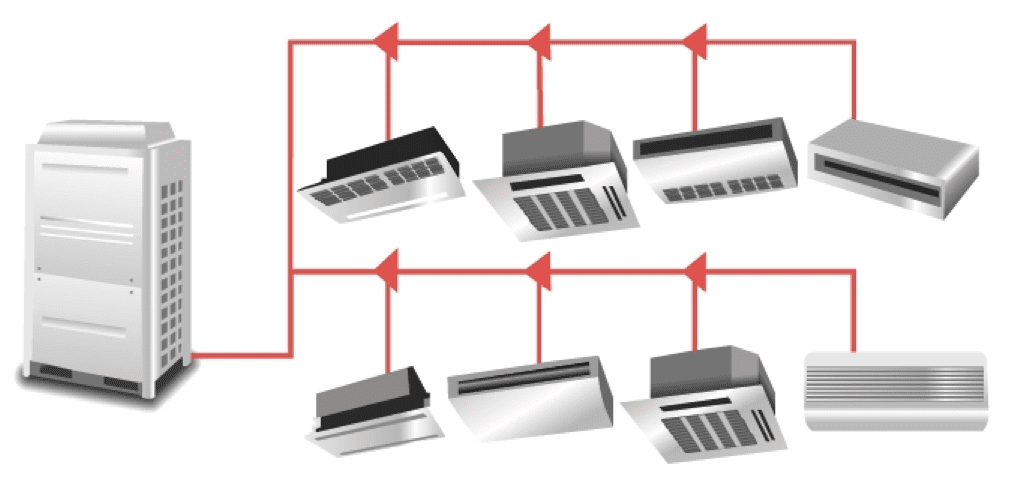
What is a Variable Refrigerant Flow (VRF) air conditioning system? Here's the definition according to ASHRAE:
The term variable refrigerant flow refers to the ability of the system to control the amount of refrigerant flowing to each of the evaporators, enabling the use of many evaporators of differing capacities and configurations, individualized comfort control, simultaneous heating and cooling in different zones, and heat recovery from one zone to another. (ASHRAE Journal, April 2007)In layman’s terms, VRF systems are essentially larger, more complex, versions of direct expansion (DX) split systems much like the one you likely have in your home. The technology was pioneered in Japan by Daikin back in the early 1980s, but has only recently gained popularity in the United States. These systems have continued to advance over the years, and numerous other notable manufacturers like LG, Mitsubishi, and Trane also offer versions of VRF systems. The diagram above indicates how a single outdoor VRF condensing unit can serve various styles of indoor units (wall mounted, ceiling cassette, concealed ducted, PTAC style). There are distinct Advantages of VRF over traditional systems, such as:
- Construction Flexibility – The modular nature of both the indoor and outdoor units simplify installation and allow for future expansion.
- Occupant Comfort – VRF systems rely largely on individual zone control and can hold a more consistent temperature in a space.
- Energy Efficiency – VRF systems are highly efficient. This carries increased importance as building energy codes are becoming more and more stringent and owners are recognizing the rising cost of energy from utilities. (These systems are often used in LEED and Austin Green Building Program compliant buildings due to their energy efficiency.)
- System Redundancy – VRF condensing units are often equipped with multiple compressors. This provides a level of redundancy as compared to standard split systems where each indoor unit is paired with a dedicated outdoor unit with a single compressor.
- Installed Capacity Reduction – A reduced total tonnage of air conditioning equipment is installed to serve a building due to the ability to shift heating or cooling capacity from one part of a building to another.
- Sound levels – VRF indoor and outdoor units create much less noise than traditional DX split systems.
- Dedicated Outside Air – A dedicated outside air system is required. The VRF indoor equipment is small/modular and not designed to process large amounts of outside air that might be required in densely occupied buildings.
- First Costs – First costs are higher when compared to other system types, but the savings in energy typically returns the initial investment within 5 years or less.