.png?width=185&height=175&name=WGI%20Icon_Green%20(1).png)


















Multiple zone Variable Air Volume (VAV) systems are very popular in commercial developments today. These systems utilize main air handlers to provide conditioned air to terminal units throughout a large area of the building. These terminal units, commonly referred to as VAV boxes, are used to control the volume and, sometimes, the temperature of air entering a designated space. There are a few different types of terminal units used in today's developments: single duct, parallel fan-powered, and series fan-powered. Each has its own correct application.
 In cooling mode, parallel FPTUs operate exactly like single duct terminal units. When heat is required by the thermostat, the fan is activated and draws warm air from the plenum above the ceiling. This air mixes with the primary air from the air handler and is then run over a heating coil. Because the fan only handles the heating airflow (which is typically less than the cooling airflow), the fan can be smaller than the fan in series FPTUs.
In series FPTUs, the fan is running constantly in both heating and cooling modes. This type of terminal unit provides a constant volume of air to the space, but varies the ratio of plenum air to primary air to maintain the desired temperature. Electric or hot water heating coils can be utilized to provide additional heat. Series FPTUs are best used in applications where constant noise is important or where retrofit applications require additional static pressure to be added by the terminal unit.
In cooling mode, parallel FPTUs operate exactly like single duct terminal units. When heat is required by the thermostat, the fan is activated and draws warm air from the plenum above the ceiling. This air mixes with the primary air from the air handler and is then run over a heating coil. Because the fan only handles the heating airflow (which is typically less than the cooling airflow), the fan can be smaller than the fan in series FPTUs.
In series FPTUs, the fan is running constantly in both heating and cooling modes. This type of terminal unit provides a constant volume of air to the space, but varies the ratio of plenum air to primary air to maintain the desired temperature. Electric or hot water heating coils can be utilized to provide additional heat. Series FPTUs are best used in applications where constant noise is important or where retrofit applications require additional static pressure to be added by the terminal unit.
Single Duct Terminal Units
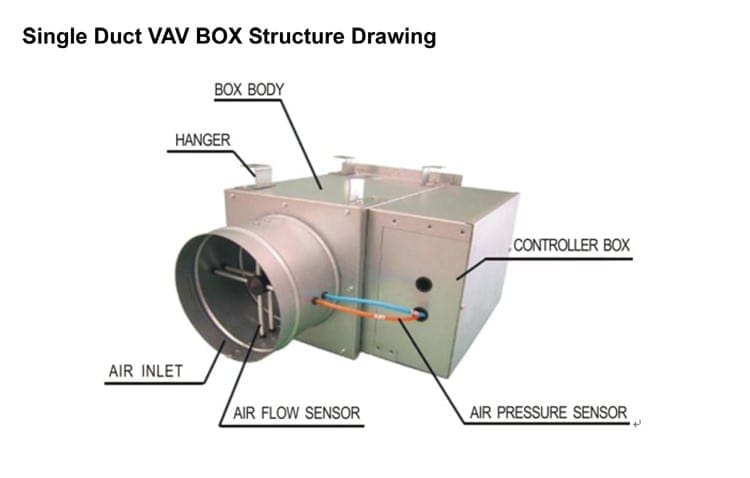
Single duct terminal units consist of a housing and a damper with an actuator. This damper is controlled by airflow sensors within the unit along with a thermostat in the space. The units are programmed with a maximum and minimum airflow, and the damper will modulate between those positions depending on how much cooling the space requires. These are often used in interior zones that don’t require heating.Fan Powered Terminal Units
Fan powered terminal units (FPTUs) consist of all the same elements, but also include a fan. These units are commonly used in exterior zones that require heat and can be provided with electric or hot water heating coils. There are two main types of fan powered terminal units: parallel and series.
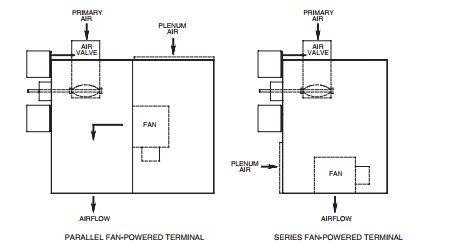
In cooling mode, parallel FPTUs operate exactly like single duct terminal units. When heat is required by the thermostat, the fan is activated and draws warm air from the plenum above the ceiling. This air mixes with the primary air from the air handler and is then run over a heating coil. Because the fan only handles the heating airflow (which is typically less than the cooling airflow), the fan can be smaller than the fan in series FPTUs.
In series FPTUs, the fan is running constantly in both heating and cooling modes. This type of terminal unit provides a constant volume of air to the space, but varies the ratio of plenum air to primary air to maintain the desired temperature. Electric or hot water heating coils can be utilized to provide additional heat. Series FPTUs are best used in applications where constant noise is important or where retrofit applications require additional static pressure to be added by the terminal unit.