.png?width=185&height=175&name=WGI%20Icon_Green%20(1).png)



















As the Commonwealth of Virginia strives to create vibrant, sustainable towns and cities, it faces a dynamic landscape of technological advancements. Emerging technologies promise efficiency, connectivity, and improved quality of life, yet policy can hinder or enable their seamless integration into urban planning and development. Urban planners, policymakers, developers, and residents grapple with balancing innovation with privacy, security, and equitable access.
In this edition of our Policy Puzzle series, we delve into a few innovative tools, their land-use planning applications, and the Commonwealth-specific policy measures that dictate their use.
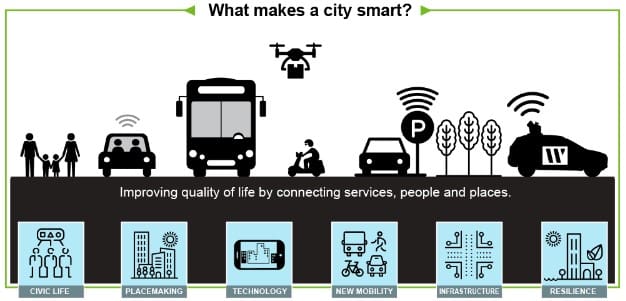 With the vast amounts of indiscriminate data collected by IoT devices, privacy is increasingly of concern. Virginia is one of four US states with a comprehensive data protection law for its residents. The Virginia Consumer Data Protection Act (VCDPA) took effect on January 1, 2023, requiring organizations to gain permission from consumers to use their data. However, it is unclear how smart infrastructure data collected by governments apply to the VCDPA.
Drones and LiDAR
Drone usage can enhance the efficiency, accuracy, and cost-effectiveness of urban planning, particularly when paired with LiDAR (Light Detection and Ranging). Here’s how they contribute.- Data Collection: Drones efficiently gather data needed for informed planning decisions. They capture aerial images, topographic maps, and 3D models of city landscapes.
- Mapping and Surveying: Drones provide precise geospatial mapping, helping planners visualize terrain, land use, and architectural details. They’re faster and more cost effective than traditional methods.
- Infrastructure Inspection: Drones inspect bridges, roads, and other infrastructure, identifying flaws and facilitating maintenance.
Smart Cities and Internet of Things (IoT)
Internet of Things (IoT) plays a pivotal role in shaping smart cities by connecting previously unconnected elements (e.g., street lights, meters, utilities) with data, devices, and people. IoT empowers urban planners to create safer, more sustainable, and efficient communities by using real-time data from IoT devices to inform decision-making.Applications of IoT in Smart Cities
- Traffic Management: Sensors monitor traffic flow, reduce congestion, and enhance safety.
- Air Quality Monitoring: Continuous emissions tracking helps combat pollution.
- Waste Management: Smart bins optimize collection routes.
- Smart Buildings: IoT systems manage energy usage, lighting, and security.
- Natural Disaster Planning: Early warning systems improve resilience2.

Artificial Intelligence and Machine Learning
Artificial Intelligence (AI) plays a pivotal role in modern urban planning, revolutionizing how cities are designed, managed, and optimized. AI empowers planners to create smarter, more sustainable cities by leveraging data collected through drones, LiDAR, and IoT devices. The following are a few applications of AI in planning:- “Digital Twins” simulate and test modifications to the urban landscape before implementation. They predict how changes in one structure or system impact the surroundings, ensuring thoughtful urban planning.
- Predictive Analytics and Simulation assess the impact of various development scenarios. Planners can make data-driven decisions for optimal land use, transportation, and infrastructure development. AI assists planners in choosing traffic routes, optimizing public transportation, and managing utilities efficiently. It analyzes environmental conditions, demographic trends, and infrastructure data to propose energy-efficient designs.
- Executive Order 30 on Artificial Intelligence (2024). This state-level approach, issued by Governor Glenn Youngkin, focuses on responsible AI integration across government agencies, schools, and law enforcement. The order directs the newly formed Virginia Information Technologies Agency (VITA) to develop AI Policy Standards, including ethical use guidelines, mandatory approval processes for AI implementation, disclaimers for AI-generated outcomes, and personal data protection measures.
- SB 487 (2024) requires an analysis of AI use by public bodies in Virginia and establishes the Commission on AI to study its impact on the state.
- HB 1496 (2024). Requires Virginia localities to provide a list of all surveillance technologies used by law enforcement agencies. While not AI-specific, this law reflects the broader context of technology adoption and transparency.