.png?width=185&height=175&name=WGI%20Icon_Green%20(1).png)



















The 2025 Texas legislative session delivered a series of landmark bills poised to reshape the future of land development and civil engineering across the state. With population growth soaring and housing demand showing no signs of slowing, state lawmakers introduced sweeping changes to reduce red tape, unlock development opportunities, and bring greater transparency to planning and permitting processes.
Taking effect on September 1, 2025, five critical bills—HB 24, SB 840, SB 1883, SB 15, and SB 6—aim to accelerate timelines, provide cost stability, and enable smarter, more flexible land use. Whether you’re a private developer looking to revitalize underutilized property, an engineer tasked with navigating municipal permitting, or a city official balancing infrastructure demands, these new laws will influence how land is planned, designed, and transformed across the Lone Star State.
 HB 24 raises the bar by increasing the protest threshold to 60%—a significant shift that means fewer projects will be caught in entitlement gridlock. Just as important, the bill removes the requirement for a supermajority vote, allowing rezoning decisions to move forward with a simple majority of council support.
This change will be especially impactful for infill developments in urban areas like Austin, Dallas, and San Antonio, where land is limited and neighbors have traditionally held outsized influence. While this law won’t apply in Houston (which has no formal zoning code), cities across Texas will benefit from a clearer path to development approvals, reducing uncertainty and helping builders deliver needed housing more efficiently.
HB 24 raises the bar by increasing the protest threshold to 60%—a significant shift that means fewer projects will be caught in entitlement gridlock. Just as important, the bill removes the requirement for a supermajority vote, allowing rezoning decisions to move forward with a simple majority of council support.
This change will be especially impactful for infill developments in urban areas like Austin, Dallas, and San Antonio, where land is limited and neighbors have traditionally held outsized influence. While this law won’t apply in Houston (which has no formal zoning code), cities across Texas will benefit from a clearer path to development approvals, reducing uncertainty and helping builders deliver needed housing more efficiently.
 To qualify, the property must have been used commercially for at least five years and be located within a city that meets the population threshold. If those conditions are met, developers can skip lengthy rezoning battles and proceed directly to permitting under existing city development standards.
Key highlights:
To qualify, the property must have been used commercially for at least five years and be located within a city that meets the population threshold. If those conditions are met, developers can skip lengthy rezoning battles and proceed directly to permitting under existing city development standards.
Key highlights:
 This new rule prevents municipalities from enforcing overly large lot requirements or creating zoning tiers that effectively ban moderate-density housing in unplatted areas.
Why it matters:
This new rule prevents municipalities from enforcing overly large lot requirements or creating zoning tiers that effectively ban moderate-density housing in unplatted areas.
Why it matters:
 At the same time, SB 1883 and SB 6 help take the guesswork out of early-stage planning by locking in costs and clarifying utility demands. That means smarter budgeting, more accurate forecasting, and fewer surprises for stakeholders.
These changes aren't just good for the bottom line; they support the kind of forward-thinking, data-informed planning that leads to more resilient, livable communities. And with demand for housing and infrastructure continuing to rise across Texas, the timing couldn't be better. For those ready to build smarter, faster, and with greater certainty - now is the time to act.
At the same time, SB 1883 and SB 6 help take the guesswork out of early-stage planning by locking in costs and clarifying utility demands. That means smarter budgeting, more accurate forecasting, and fewer surprises for stakeholders.
These changes aren't just good for the bottom line; they support the kind of forward-thinking, data-informed planning that leads to more resilient, livable communities. And with demand for housing and infrastructure continuing to rise across Texas, the timing couldn't be better. For those ready to build smarter, faster, and with greater certainty - now is the time to act.
HB 24 — Easing Neighborhood Protest Thresholds
Historically, even well-planned, council-supported development proposals could be derailed by vocal neighborhood opposition. Under existing rules, if 20% of adjacent landowners protested a proposed rezoning, it triggered the need for a supermajority council vote, which could be hard to secure and often resulted in project delays or denials.
SB 840 — By-Right Conversion of Underused Commercial Property
SB 840 opens the door to a dramatic reimagining of the built environment in Texas. In cities with populations of 150,000 or more (in counties over 300,000), qualifying commercial properties, like strip malls, aging office buildings, or warehouse spaces, can be converted by-right into multifamily or mixed-use developments. No zoning change. No variance. No special-use permit. To qualify, the property must have been used commercially for at least five years and be located within a city that meets the population threshold. If those conditions are met, developers can skip lengthy rezoning battles and proceed directly to permitting under existing city development standards.
Key highlights:
To qualify, the property must have been used commercially for at least five years and be located within a city that meets the population threshold. If those conditions are met, developers can skip lengthy rezoning battles and proceed directly to permitting under existing city development standards.
Key highlights:
- Minimum 65% of the floor area must be multifamily residential.
- Cities must allow development at maximum residential densities permitted anywhere within their jurisdiction.
- Local restrictions on height, parking, setbacks, and floor area ratios are capped or preempted.
- Certain fees and studies (e.g., traffic impact analyses) are waived to encourage redevelopment.
SB 1883 — Bringing Cost Certainty to Impact Fees
One of the most significant pain points in development planning is unpredictability around impact fees - the charges municipalities impose to fund roads, utilities, and public infrastructure. Under current rules, these fees can change unpredictably, making it difficult for developers to budget and plan long-term. SB 1883 solves that by locking impact fees in place for a three-year period following adoption or any increase. Additionally, cities are now required to:- Conduct independent audits of impact fees.
- Secure a two-thirds vote of the council to implement fee increases.
SB 15 — Protecting Build Rights on Large, Unplatted Lots
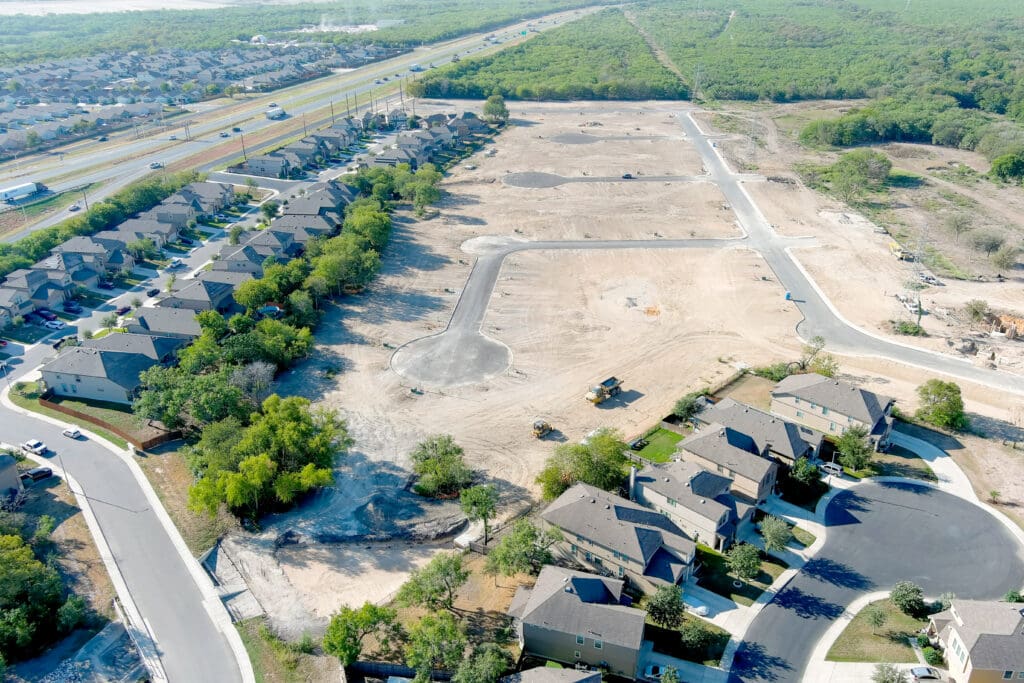
SB 15 takes aim at restrictive local zoning rules that can stifle rural or fringe development. The bill mandates that new single-family homes on unplatted parcels of five acres or more must be allowed with minimum single family lot sizes of 3,000 square feet, regardless of local minimum lot size standards. This new rule prevents municipalities from enforcing overly large lot requirements or creating zoning tiers that effectively ban moderate-density housing in unplatted areas.
Why it matters:
This new rule prevents municipalities from enforcing overly large lot requirements or creating zoning tiers that effectively ban moderate-density housing in unplatted areas.
Why it matters:
- Developers and homebuilders gain more flexibility to build in semi-rural and edge-of-town parcels without being forced into inefficient lot layouts.
- Civil engineers will have expanded scope for site planning, roadway layout, utility design, and water management, especially in areas where services are less centralized.
- Any project with an electric load of 75 megawatts or more to fund a load study.
- Some power providers, like CPS Energy, were already doing this at 40 megawatts
- Developers are to disclose all other locations in Texas where they are pursuing similar energy requests.
The Big Picture
Together, these legislative reforms represent a bold step toward modernizing Texas’s development landscape. By stripping away outdated regulatory barriers, encouraging adaptive reuse of aging commercial properties, and introducing greater predictability in impact fees and energy requirements, the state is clearly prioritizing housing production, economic growth, and infrastructure efficiency. For developers and civil engineers, the impacts will be felt across every phase of a project’s lifecycle, from site selection and due diligence to permitting and construction. Projects that might have stalled due to neighbor opposition or uncertain rezoning timelines may now move forward with greater speed and less friction. Previously overlooked sites - like vacant retail centers or office parks - could become tomorrow’s housing hubs, thanks to SB 840’s streamlined conversion pathway.