.png?width=185&height=175&name=WGI%20Icon_Green%20(1).png)
















Florida’s wetlands are among the state’s most valuable natural resources; they filter stormwater, provide critical wildlife habitat, and help buffer communities from flooding. Yet many of these ecosystems face ongoing pressure from invasive species to increasing development demands. Protecting and restoring wetlands requires a careful balance of science and creativity.
That balance is at the core of WGI’s Environmental practice. From early environmental assessments and permitting to restoration design and long-term monitoring, our team works to bring degraded wetlands back to life in ways that benefit both the environment and the communities that surround them.
In this spotlight, we’re highlighting several ongoing and completed wetland restoration efforts across Florida. Each project presents unique challenges and solutions, but together they demonstrate how thoughtful, well-executed restoration can create lasting environmental and community value.
Hendrix Reserve – Cypress Preservation and Buffer Creation
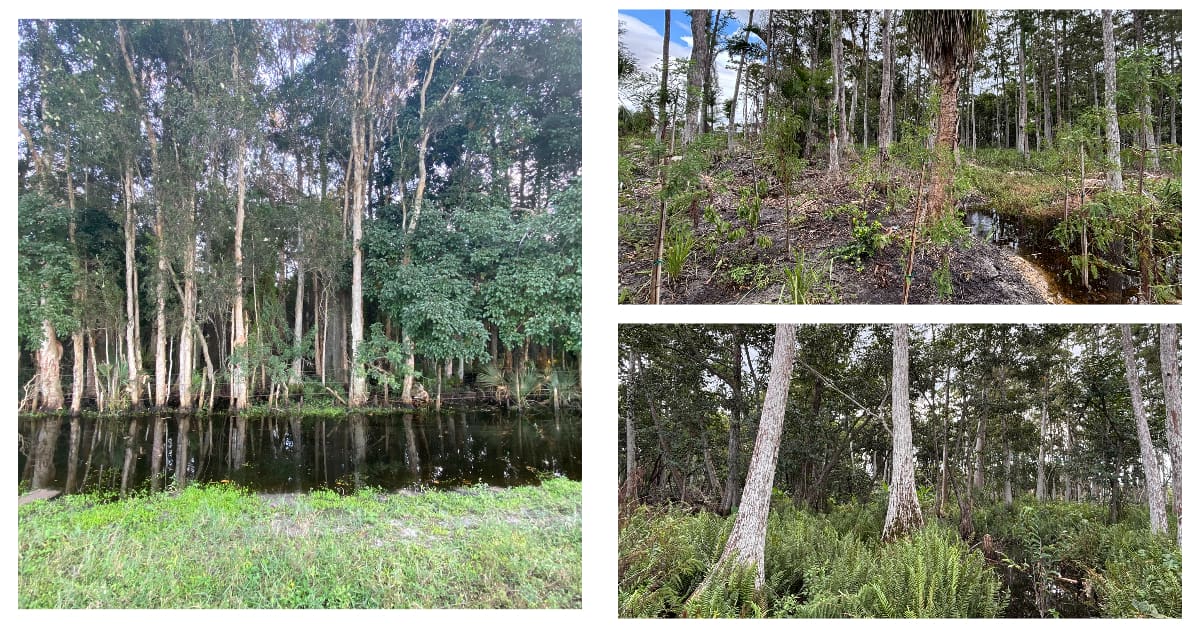 Hendrix Reserve’s cypress wetlands before and after invasive species removal.[/caption]
Within the 36.49-acre Hendrix Reserve property lie 2.64 acres of cypress wetlands that had become severely impacted by invasive vegetation. Dense stands of melaleuca and Brazilian pepper crowded out native species, threatening the wetland’s ecological function and long-term viability.
WGI developed a targeted restoration plan focused on removing invasive species, reestablishing native vegetation, and creating a protective wetland buffer to shield the area from nearby development. The approach was straightforward but impactful; restore the wetland’s natural processes while providing long-term protection.
Status: Invasive species removal has been completed by hand, debris clearing is underway, and native planting is scheduled next. The site will be monitored over the next five years to ensure successful establishment and continued ecological health.
Team Insight:
“This project really highlights the importance of patience in ecological work. Each step - removal, clearing, planting - builds on the last. You can’t rush nature, but you can set it up for success.”
Trotting Center – A Wetland Designed for Wildlife
 Bird Island was designed to create roosting space for wading birds.[/caption]
The 100-acre Trotting Center property contained approximately 10.5 acres of wetlands, many of which were previously constructed drainage swales surrounding the former horse track rather than natural wetland systems. WGI’s design focused on preserving and enhancing the majority of the site’s natural wetlands by restoring 1.61 acres of cypress and marsh habitat.
A unique aspect of the project was the creation of a large lake with a littoral shelf and a dedicated Bird Island designed to provide roosting habitat for wading birds. Together, these features create a diverse ecological system that supports nesting, foraging, and shelter for a variety of wildlife species.
Status: Exotic species removal is ongoing, monthly maintenance is underway, and planting is scheduled for the cypress wetland, herbaceous marsh, littoral shelf, and Bird Island.
Team Insights:
“For the Trotting Center project, I helped delineate the onsite wetlands. It was a great example of coordinating natural resource assessments to support early project planning.”
“The establishment of Bird Island specifically targeted recruitment of native and migratory birds. It was rewarding to be part of a project that took such a unique approach to conservation.”
Coconut Crossing – Overcoming Two Decades of Constraints
 Reshaping Coconut Crossing’s wetlands to maintain consistent water levels.[/caption]
For more than 20 years, development at the Coconut Crossing site stalled due to challenging wetland conditions. Depressional wetlands and inconsistent water levels made the site difficult to design and permit.
WGI helped change that trajectory by securing environmental permits and designing a large herbaceous marsh capable of maintaining consistent hydrology for semi-aquatic species. Using vertical relocation, our team relied on detailed surveys, hydrologic analysis, and historic water level data to support both ecological function and development goals.
Status: Earthwork is nearly complete, slopes are being stabilized, and planting is forthcoming. Early water level data already indicate conditions are aligning with design expectations.
Team Insight:
“This project was about seeing potential where others only saw obstacles. We turned a difficult site into a functioning wetland system that supports both the environment and the community.”
SAFStor Pembroke – From Overrun to Thriving Habitat
 Native vegetation thriving at SAFStor Pembroke after restoration (first picture before).[/caption]
When WGI began work at SAFStor Pembroke, the entire 9.14-acre site consisted of degraded wetland dominated by invasive melaleuca, with little to no ground cover. The challenge was ambitious: accommodate development while restoring nearly two acres of functional wetland habitat.
Through vertical relocation, integration with stormwater management design, and the creation of herbaceous marsh, deepwater refugia, and a wetland buffer, WGI transformed the site into a thriving ecosystem. Today, more than 20 bird species have been documented on-site: a clear indicator of restoration success.
Team Insight:
“The diversity of wildlife returning here shows that when you give nature the right conditions, it rebounds quickly. This project is living proof.”
Sterling Ranch – A Wetland Oasis in an Urban Landscape
 Restored freshwater marsh habitat connecting larger preserves in Broward County.[/caption]
At the center of the 96.43-acre Sterling Ranch development lies a 10-acre wetland mitigation area that now functions as a vital wildlife corridor. WGI restored 7.95 acres of degraded wetlands, created 1.57 acres of new wetlands, and designed a diverse mosaic of freshwater marsh, forested wetland, transitional marsh, and open water habitat.
This habitat closely reflects historic wetland conditions and provides an essential ecological link between larger preserves to the north and south, an increasingly rare asset in urban Broward County.
Status: The project reached its five-year monitoring milestone in 2024 with complete success and is now used as a training example by Broward County’s Resilient Environment Department.
Team Insight:
“This project became a critical link between larger preserves. In an urban area, that’s rare and incredibly valuable for wildlife movement.”
Looking Ahead
Each of these projects tells its own story, but together they more largely reflect the resilience of Florida’s wetlands and the importance of restoring them with care and intention. Areas once overrun by invasive species or shaped by altered water flows are now transforming into functioning ecosystems again. Native plants are taking root, water levels are stabilizing, and wildlife is returning to places where it had long been absent.
As Florida continues to grow, the responsibility to protect and restore its natural systems becomes even more critical. Through collaboration and a deep understanding of environmental processes, WGI remains committed to helping wetlands recover and thrive. The success of these projects demonstrates what’s possible when development and environmental stewardship move forward together, ensuring these landscapes continue to support wildlife, protect communities, and preserve the natural heritage.
Contact Us
Whether you’re navigating wetland challenges on a development site, planning a restoration project, or exploring the ecological potential of your property, WGI’s Environmental team is ready to help.
Contact our experts to turn your complex environmental conditions into lasting success stories!