.png?width=185&height=175&name=WGI%20Icon_Green%20(1).png)



















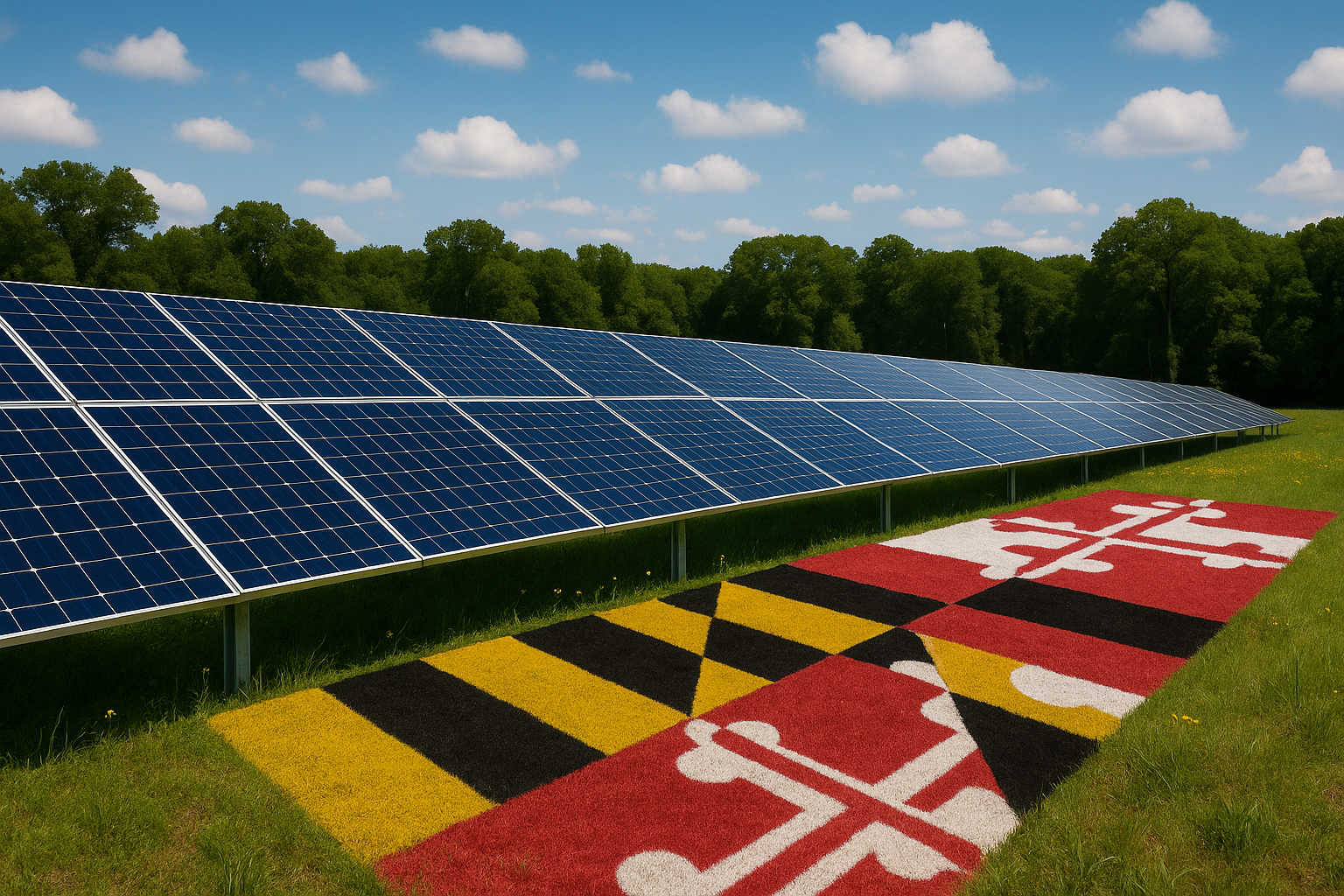
Why the Renewable Energy Certainty Act Matters
For years, solar developers in Maryland have navigated a complex landscape of inconsistent local regulations, prolonged permitting delays, and unclear review processes for distributed generation projects. These projects typically involve solar systems under five megawatts, including both commercial rooftops and small utility-scale arrays.
Key Provisions of the Act
1. New Certificate for Distributed Solar Projects: The Act establishes a new type of Certificate of Public Convenience and Necessity (CPCN) specifically for distributed generation projects. Unlike the traditional CPCN, which was designed for large power plants and utility-scale infrastructure, this tailored certificate streamlines review for smaller projects.
-
- Eligible systems include solar, battery storage, or hybrid installations under 5 MW.
- Review is handled by the Public Service Commission (PSC) with reduced documentation and timelines.
- Environmental and community impact assessments are still required, but now standardized.
2. Uniform Siting and Design Standards: The Act directs the Power Plant Research Program (PPRP) to develop a statewide siting and design manual by July 1st, 2026. This manual will:
-
- Define criteria for site layout, access, visual screening, vegetation management, and decommissioning.
- Apply to systems located on rooftops, brownfields, parking lots, farmland, and open space.
- Preempt inconsistent local ordinances that contradict state standards.
This could be a big change for local planning departments. Jurisdictions must now align their site plan review procedures with these uniform standards, or risk delay penalties for non-compliance.
3. Fast-Tracked Local Review: Once a project meets the statewide standards, the local government is required to expedite site plan approval, typically within 60 days. Failure to act within this timeframe can trigger automatic approval or PSC intervention. This measure ensures that projects don't stall for months due to procedural gridlock or political inertia at the local level.
Environmental Protections and Equity Considerations
Although the Act streamlines approval, it does not abandon environmental safeguards. The siting manual must include:- Minimal grading and impervious surface disturbance.
- Soil protection and vegetation buffers.
- Requirements for decommissioning bonds to ensure responsible end-of-life site restoration.
Implications for Local Governments and Planners
The Renewable Energy Certainty Act shifts Maryland toward a state-led solar permitting framework, similar to approaches seen in states like California and New Jersey. While the local zoning authority remains intact, it is now nested within a clearer regulatory framework. Local governments must:- Update zoning codes and subdivision regulations to recognize distributed solar as a permitted or conditionally permitted use in most zones.
- Coordinate with state agencies on site plan thresholds and environmental review.
- Educate staff on the new CPCN process and integrate it into development workflows.
How This Ties Into Maryland’s Broader Solar Strategy
While the Renewable Energy Certainty Act provides the regulatory backbone, it works in tandem with other recent policies:- The Community Solar Program Expansion, set to begin in 2025, ensures residents without rooftop access can still participate in clean energy.
- HB 1111 in 2025 incentivizes solar on quarries, brownfields, and industrial sites.
- The Solar Access Grant Program offers financial support for low-income rooftop adoption.