By Rob McConnnell, PE, SE
Parking technology has advanced rapidly in recent years. Camera-based systems, mobile payments, EV charging, parking guidance, and AI-driven analytics platforms are transforming how parking facilities operate. For owners and operators, however, adopting new technology is rarely just about innovation. The central question is always the same: will it deliver measurable value and a clear return on investment (ROI)?
Determining the ROI of parking technology requires more than simply comparing a system’s cost to the revenue it generates. Many of the most valuable technologies influence occupancy, operational efficiency, labor costs, and customer experience. Those improvements often translate into revenue growth and cost reductions, significantly improving a facility’s financial performance.
Understanding how to evaluate those impacts — and how to build a strategic implementation plan — is essential for parking owners who want to modernize their facilities without overinvesting in unnecessary technology.
Understanding the Economics of Parking Infrastructure
To appreciate the value of parking technology, it helps to understand the economics of parking facilities themselves. The cost of constructing structured parking continues to rise, with the national median cost of building a single parking space now approaching $35,000. In dense urban areas or complex mixed-use developments, costs climb even higher.
Against that backdrop, many parking technologies represent a relatively modest incremental investment. Even systems considered relatively expensive, such as individual space-occupancy parking guidance, typically add only about a 2% premium to the overall cost of constructing a parking facility.

Because the underlying asset is so expensive, even small improvements in utilization or operational efficiency can produce meaningful financial returns. For example, increasing occupancy from 85% to 95% in a high-demand facility can represent hundreds of additional transactions per day in a large garage. That additional revenue can often offset the cost of new technology relatively quickly.
This relationship between infrastructure costs and operational performance is why many parking owners now view technology as an essential component for maximizing the value of their parking assets.
Occupancy Optimization Through Parking Guidance
One of the clearest examples of technology delivering measurable ROI is parking guidance.
Before the widespread introduction of parking guidance systems, many operators assumed that facilities would effectively “top out” at about 85% occupancy. Beyond that level, drivers begin to experience frustration searching for spaces. Long search times can lead some customers to abandon the facility entirely and seek parking elsewhere.
Parking guidance systems change that dynamic by identifying available spaces and quickly directing drivers to them. Sensors or cameras detect open spaces and communicate that information through dynamic signage and, often, red and green LED lighting inside the garage. By reducing the time drivers spend searching for parking, these systems can push occupancy to 95% or higher. In busy facilities, that improvement can translate directly into increased revenue.
Guidance systems also improve customer satisfaction by reducing stress and uncertainty during the parking process. In environments with large numbers of occasional users, such as airports, hospitals, and shopping centers, this convenience can significantly influence a facility’s reputation and repeat usage. The technology tends to provide the greatest value in larger garages, particularly those with more than three parking bays, where drivers may miss available spaces in their search.
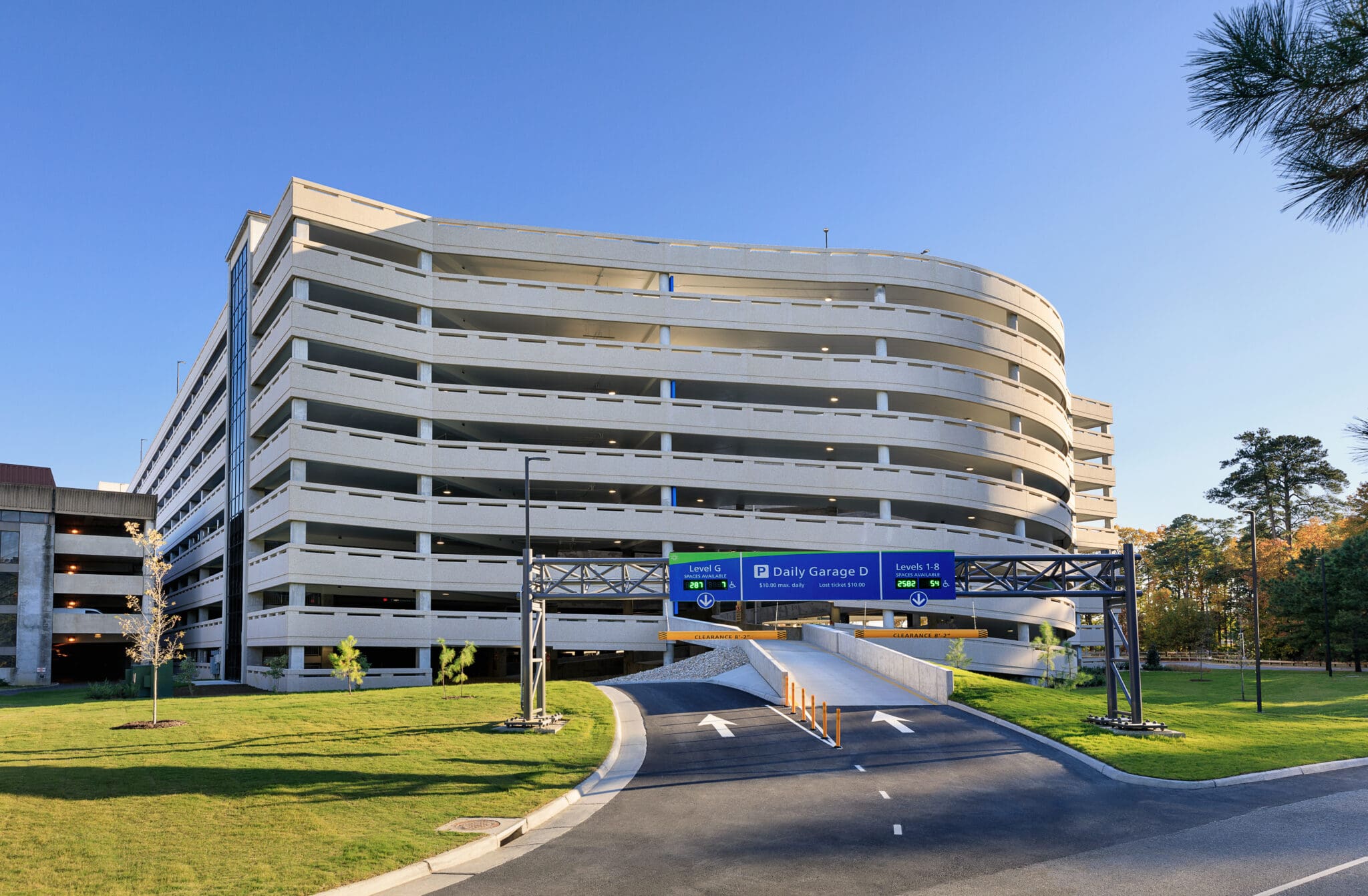
The external signage that’s typically associated with parking guidance technology can also deliver measurable ROI. Dynamic signage located outside a garage can display real-time information about available parking spaces. When integrated with a city’s broader parking ecosystem, these systems help drivers identify available parking before they even reach the facility. This visibility can attract drivers from nearby streets who might otherwise assume the garage is full and choose another location.
For garages in dense urban districts or near major destinations, external guidance systems function as both a customer service tool and a marketing platform. By capturing demand from passing drivers, these systems can increase facility utilization and generate additional revenue that might otherwise be lost.
Frictionless Parking and Operational Efficiency
Another technology-based operating approach that’s gaining significant traction is “free-flow” or “frictionless” parking, which typically eliminates traditional gated systems and replaces them with license plate recognition (LPR) cameras. In conventional gated facilities, entry and exit gates require ongoing maintenance and repair. Hardware failures, ticket jams, and equipment wear can create operational disruptions and recurring maintenance costs. Ungated frictionless systems remove those mechanical components entirely.
LPR cameras record the license plate of each vehicle entering and exiting the facility. The operating software determines whether the vehicle is authorized to be there and whether it has overstayed its allotted time. For certain operations, the software can automatically open a parking session on entry, calculate the duration of the stay, and automatically process payment on exit. The integration of mobile apps and online payment platforms provides convenience and comfort for most users. While frictionless systems require investment in cameras and software, they can reduce long-term maintenance costs. These systems are usually coupled with directed or automated enforcement capabilities, which can also reduce the need for enforcement personnel to manually patrol garages and check vehicles for compliance. LPR can also quickly identify black-listed vehicles entering a facility, and when integrated with law enforcement databases, identify stolen or otherwise flagged vehicles.

In effect, these systems streamline operations, improve enforcement effectiveness, and provide significant information on occupancy, customer habits, and other data points.
Mobile and Online Payments and Reduced Transaction Costs
Mobile payment platforms and online prepaid parking reservations are other areas where parking operators can realize both operational and financial benefits. Traditional payment systems require hardware such as pay stations, ticket dispensers, and cash handling equipment. These systems carry capital costs, maintenance requirements, and operational risks associated with handling cash.
Mobile payment systems allow drivers to pay for parking via smartphone apps, while online platforms enable customers to prepay prior to parking. When customers adopt either system, operators can reduce their reliance on physical payment equipment. Eliminating or reducing cash payments also improves security and reduces revenue leakage associated with cash handling. Prepaid reservations also enable operators to forecast occupancy and adjust rates, as well as the amount and location of preferred parking spaces and other variables accordingly.
Similarly, in on-street parking environments, the shift toward mobile payment reduces the cost of maintaining and collecting revenue from parking meters. Mobile platforms and online prepaid reservations enable cities and operators to collect parking fees digitally, eliminating the need for frequent meter collection.
Perhaps most importantly, these systems often require relatively modest investment compared with traditional hardware-based payment infrastructure.
Revenue Generation Through Third-Party Reservations and Marketing Platforms
Another way parking owners can increase revenue is by utilizing third-party reservation and marketing platforms. These platforms allow owners and operators to market and sell parking spaces in advance, often through online marketplaces, travel websites, or sports and entertainment venues. By making inventory visible to a wider audience, operators can fill spaces that might otherwise remain unoccupied during certain times of the day or year.

Airports, cruise ship terminals, and event venues have particularly benefited from reservation platforms, which allow travelers or event attendees to secure parking in advance, often with their ticket purchase. But really, any garage or parking lot that serves transient parking customers can benefit from them. These platforms provide a relatively low-cost way to increase utilization and revenue without requiring significant infrastructure changes.
EV Charging as an Emerging Revenue Opportunity
The rapid adoption of electric vehicles (EVs) is creating new opportunities for parking operators to generate revenue through EV charging infrastructure. Many drivers now expect charging availability as part of the parking experience, particularly at destinations where vehicles remain parked for several hours. Airports, hospitals, office campuses, and universities are particularly well-suited for this type of charging environment. Parking operators can generate revenue by marking up the cost of power, charging convenience fees for equipment use, charging valet fees for charging after a long-term stay (e.g., at airports), or charging premium rates for EV charging spaces.
While EV charging infrastructure does require upfront investment, demand for these services continues to grow as EVs become more common. Additionally, there are often subsidies and incentives to offset the cost of EV charging infrastructure, particularly for facilities near highways. As EV adoption increases, this infrastructure can become both a customer amenity and a revenue generator.
Data Platforms and AI-Driven Optimization
Beyond customer-facing technologies, a new generation of back-office platforms is emerging, focusing on data integration and operational analytics. These systems collect and aggregate data from parking transactions, occupancy sensors, payment systems, and other operational sources. Using advanced analytics — and increasingly artificial intelligence — operators can identify patterns in demand, pricing sensitivity, and operational performance.

These insights can help operators determine whether their facilities are running as efficiently as possible. For example, analytics platforms may reveal opportunities to adjust pricing, improve enforcement strategies, or reallocate parking inventory.
Some large parking operators have developed proprietary platforms for this purpose, while independent software companies offer systems designed to work across multiple parking environments. In many cases, the insights generated by these platforms can lead to operational improvements that increase efficiency, profitability, and customer satisfaction.
Building a Technology Implementation Plan
While the potential benefits of parking technology are substantial, successful implementation requires careful planning. Parking owners must weigh the cost of new technology against the value it is expected to deliver. Not every facility requires every type of technology.
Facilities serving primarily monthly parkers or employee parking may not benefit as much from revenue-generating technologies designed for transient parking environments. Conversely, facilities serving large numbers of occasional users — such as airports, hospitals, and retail centers — often benefit the most from technologies that improve customer experience and capture additional demand. Facility size also plays a role. Larger garages tend to see greater benefits from technologies like parking guidance because of the complexity of navigating the facility.
Timing is another important factor. Installing technology during new construction is typically far less expensive than retrofitting existing facilities. Owners planning new garages often incorporate technology infrastructure during the design phase to reduce installation costs later.
Ultimately, the most effective technology strategies focus on solving specific operational challenges rather than simply adopting the newest innovations. By identifying areas where technology can improve occupancy, reduce costs, enhance customer service, or generate new revenue streams, parking owners can build a technology implementation plan that delivers measurable value and long-term ROI. As the parking industry continues to evolve alongside advances in mobility, digital payments, artificial intelligence, and vehicle technology, facilities that strategically integrate technology will be best positioned to maximize the performance and value of their parking assets.
To access the original article, please click here.