By Eric Luttmann, AIA and Raymond Smith
The city of Georgetown, Texas, is writing a new chapter in its story with the completion of its first structured downtown parking garage. This functional and symbolic centerpiece will anchor growth, improve accessibility, and support the city’s evolving character.
Georgetown has long struck a balance between the pastoral and the progressive. On one hand, it’s a “rural city” in spirit: verdant surroundings, open spaces, and a strong sense of local identity. On the other hand, it is unmistakably a “growing city,” with increasing development pressure on its downtown, rising demand for housing and services, and a downtown square that draws more foot traffic than ever. The new parking garage is the product of that contradiction and transition: a strategically developed facility that bridges rural charm and urban growth, while triggering a new phase of downtown revitalization.
For decades, Georgetown’s downtown square has been a magnet for locals, tourists, festivals like the Red Poppy Festival, and small businesses. It represents a slice of Texas history, where preserved architecture meets lively local culture. But as the city has grown, so has the strain on parking and pedestrian circulation. The narrow, historic street grid that once served a smaller population now faces far greater demand from residents, employees, and visitors alike. In 2019 alone, the city welcomed 40 new businesses to downtown, and city planning estimates suggest that, had those businesses been built farther out, they would have required nearly 700 additional parking spots. But because they are downtown, visitors, staff, and patrons have had to rely on existing parking resources, often parking on neighboring residential streets or looping repeatedly around the square in search of open spaces.
This parking shortage was not simply an inconvenience; it was a constraint on growth. Businesses depend on predictable, convenient parking to thrive, and the city’s ability to attract future investment depends on its capacity to manage mobility effectively. Georgetown recognized that to maintain the charm and vitality of its downtown, it had to invest in infrastructure that could scale with growth.
Hence, the city’s 2015 Downtown Parking Study recommended the development of structured parking to support the downtown core. The study was a blueprint for future mobility, envisioning a system of strategically placed garages to support long-term development while reducing reliance on surface lots. The new garage is the first of two planned parking facilities, setting the tone for a downtown that is not only accessible but also designed for the future.
More Than A Parking Deck
The garage is Georgetown’s first truly structured downtown parking facility. The mixed-use design includes four parking levels with 315 spaces coupled with public amenities and commercial space intended to house city offices and meeting rooms. It is, in many ways, the city’s first significant investment in vertical infrastructure: a sign that Georgetown’s growth is not only outward but upward.
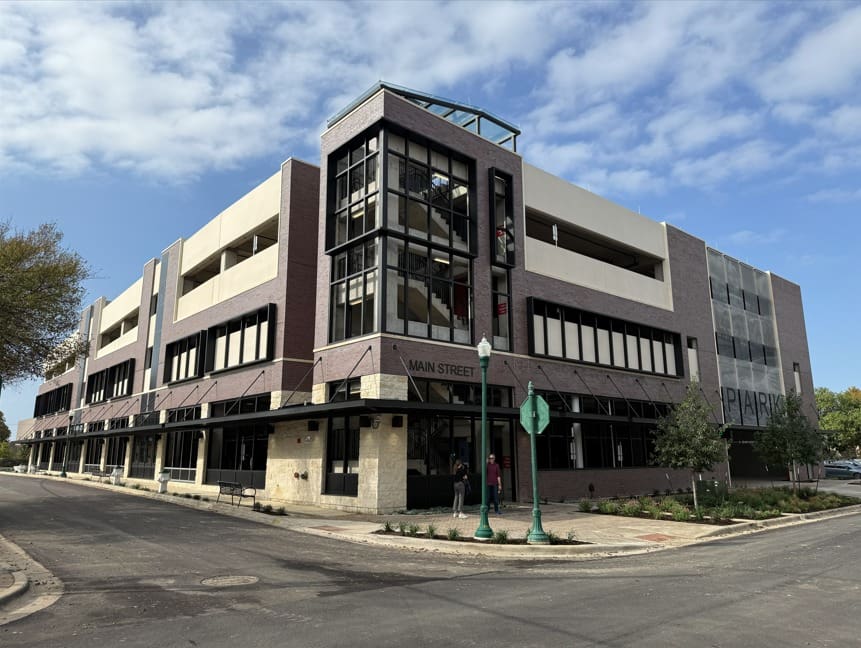
The garage offers a nice mix of form and function, including:
- Dual entry points / vertical circulation: The garage is accessible from Main Street at one corner and Austin Avenue at the opposite corner, with each entry zone offering stairs and an elevator to facilitate pedestrian movement. These dual access points improve both convenience and safety, ensuring that vehicles and pedestrians can flow through the site without congestion. They also serve as connectors to the broader downtown grid, allowing users to step directly into the rhythm of city life.
- Facade and materials: Although built of concrete, the design incorporates brick and limestone accents to echo the architectural character of the town square. Deep aluminum canopies and storefront facades on the first and second levels help to animate the streetscape and frame active frontage. It’s intended to stand on its own as a community landmark—one that respects Georgetown’s historic fabric while introducing a forward-looking architectural statement.
- A true mixed-use development: The building offers roughly 4,000 square feet of commercial and city-function space (e.g., offices, meeting rooms) on the lower levels. These spaces will bring daily foot traffic and year-round activation, helping to ensure that the structure is more than a passive place for vehicles to park.
- Future-proofing and enhancements: The garage is outfitted with infrastructure to facilitate future electric vehicle charging stations, and it includes motorcycle parking at street level. Also, it supports a parking count system with dynamic signage to guide drivers to available parking spaces. This technology-driven approach reflects Georgetown’s desire to make parking responsive, efficient, and adaptable to future transportation modes.
- Scale and setback: The creative design includes a below-grade level and an upper level that is set back to reduce the perceived height. So, while the garage offers an impressive amount of parking, it doesn’t overwhelm the architectural essence of downtown. The proportions have been carefully considered so that from a pedestrian’s perspective, the building feels like a natural extension of downtown, not a departure from it.
Funding for the $19.8 million project came from a variety of sources, including the American Rescue Plan Act, certificates of obligation bonds, and the Georgetown Downtown Tax Increment Reinvestment Zone (TIRZ). Every dollar invested in this project is expected to generate returns through increased downtown commerce, property values, and tourism.
A Design For Walkability, Connectivity, And Downtown Activation
The garage is much more than a place to park; it’s a deliberate piece of infrastructure designed to help the city achieve its broader vision of a walkable, connected downtown. In fact, it’s a key element of the city’s long-range downtown strategy, and it will impact the community in several important ways.
Perhaps the most direct benefit is that it will relieve pressure on neighboring streets by diverting visitors away from parking in residential areas. As more foot traffic and destination visits concentrate downtown, the tendency for people to find “unofficial” parking in adjacent blocks has grown. This garage, conveniently located, should reduce that pressure and restore the neighborhood’s quality of life.
The garage will also support downtown businesses and neighborhood activation. With storefronts on lower levels and modern façade elements, the structure is intended to integrate into the pedestrian experience. It will not be an isolated deck set back from activity, but a natural extension of the downtown environment. Office and meeting spaces for city and tourism staff will mean more day-in, day-out presence downtown, further animating the area. That steady presence is crucial for sustaining vitality beyond weekends and special events.
Georgetown’s downtown has a distinct architectural identity: historic brick, pedestrian scale, and visual harmony. By wrapping the concrete structure with brick and limestone veneer and employing setbacks and façade treatments, designers have created a garage that “fits in” rather than stands out as a monolithic intrusion. This thoughtful approach ensures the garage supports the downtown experience rather than detracts from it. The result is a building that respects context while quietly reshaping it.
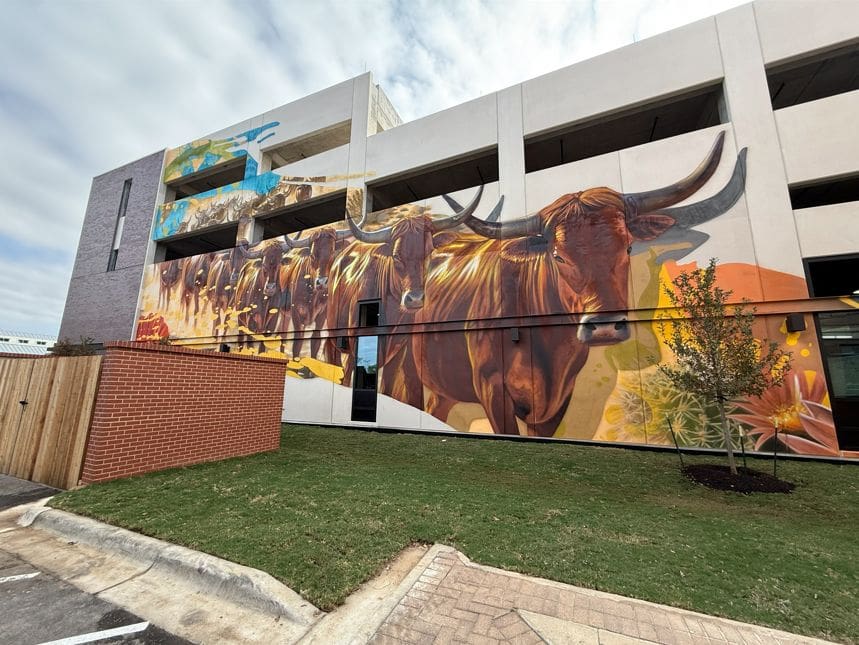
The design also enhances connectivity. The dual access points (Main and Austin) are more than practical; they connect major pedestrian corridors. Elevators and stair towers allow seamless movement vertically, helping integrate the garage into the walking network, and dynamic signage will guide users efficiently. As Georgetown continues to invest in walkability through improved sidewalks, lighting, and street amenities, the garage becomes an anchor for a connected, human-scale downtown.
The garage is also intended to provide long-term solutions and to be scalable for evolving mobility. Incorporating EV charging infrastructure and space for motorcycles reflects the garage’s design as adaptable to emerging transportation trends. As electric vehicles become more common and as shared mobility options evolve, this structure is ready to accommodate those changes without requiring major retrofits.
Finally, the project reflects Georgetown’s confidence and momentum. Such a prominent public project signals commitment to downtown development and sets the stage for further private investment and densification. The city has already seen renewed interest from small developers and entrepreneurs looking to establish a presence near the square. The garage communicates that Georgetown is “open for business” while protecting the qualities that make it special.
An Engine of Downtown Transformation
The new garage’s value extends well beyond mere convenience: it will be a catalyst for business development, creating a more walkable city, and improving the quality of life for residents. By freeing up parking constraints, it encourages more people to confidently visit downtown Georgetown, stay longer, and explore side streets, supporting local businesses. It underpins the city’s vision to make downtown a dense, vibrant place rather than a weekend destination alone.
At the same time, it benefits residents, reducing the risk that visitors will park on residential streets. So, while the garage will encourage more visitors to come to Georgetown, it will also ensure that residential parking spaces are available to residents. This balance between attracting activity and maintaining neighborhood integrity is essential to the city’s long-term livability.
In designing the structured parking facility with mixed uses, street-level activity, and pedestrian integration, Georgetown is signaling that its downtown is not merely a historic relic, but a dynamic heart for the city’s present and future. The garage stands as a physical reminder that smart growth doesn’t happen by accident. It’s the product of foresight, collaboration, and commitment to design excellence.
Just as importantly, the project represents a philosophical shift in how Georgetown approaches infrastructure. The city could have built a simple, utilitarian parking structure, but instead it invested in something that contributes to urban life. It treats parking not as a problem to be solved but as an opportunity to be leveraged.
This new garage is the first structural infrastructure investment in the evolving downtown. It is a statement: Georgetown is not merely letting growth happen; it is shaping it with intention. When visitors glide into one of its 315 parking spaces and walk out into a lively, connected square, they’ll see a physical manifestation of a city that honors its past while building for tomorrow.
The completion of this facility also marks a milestone in Georgetown’s journey toward becoming one of the region’s most thoughtfully planned cities. As growth continues across Central Texas, many communities struggle to balance expansion with identity. Georgetown’s approach—anchoring growth through infrastructure that enhances both function and beauty—offers a model for how small cities can evolve without losing their soul.
Ultimately, the success of the garage will be measured not just in occupancy rates, but in how much it contributes to the energy of the square, the confidence of its businesses, and the comfort of its residents. Georgetown’s first downtown parking facility is more than a garage. It’s an investment in the kind of city Georgetown aspires to be: connected, forward-looking, and distinctly its own.
To access the original article, please click here