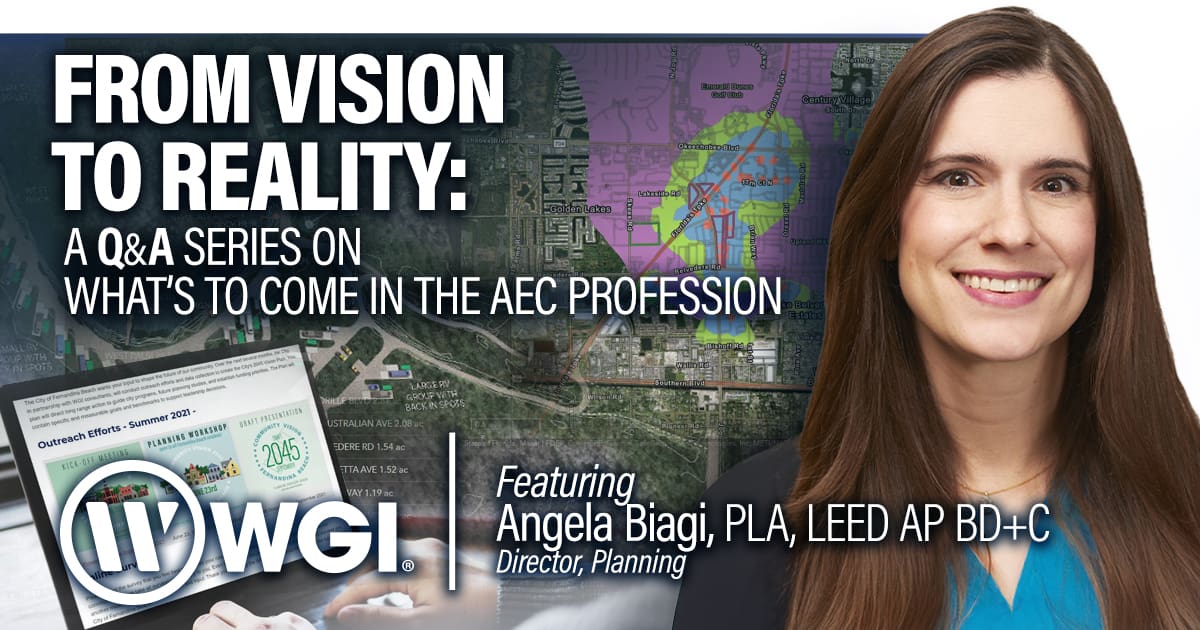
Featuring Angela Biagi, Director of Planning
In the latest edition of From Vision to Reality, we spotlight Angela Biagi, PLA, LEED AP BD+C, WGI’s Director of Planning, as she shares her forward-looking perspective on the future of planning and design in the AEC industry.
As cities and communities continue to evolve, Angela emphasizes the importance of innovation in shaping the built environment. From advancing urban design and complete streets to embracing multimodal transportation networks, she highlights how these strategies are redefining what it means to create spaces that are not only livable today but resilient and adaptable for tomorrow.
Drawing on her background in Landscape Architecture and her deep expertise in planning, Angela and her team are leading efforts to help agencies prepare for what’s next – Whether it’s reimagining corridors and public spaces or modernizing comprehensive plans and zoning codes, she’s focused on creating smarter, safer, and more connected communities that will thrive well into the future.
1. What is your outlook on the current state of the AEC profession?
We are witnessing strong demand for public projects as communities pursue growth that is smarter, more connected, and more resilient. Over the next 12–24 months, the focus will increasingly shift toward sustainability and technology.
At WGI, we bring together planners, engineers, environmental specialists, and permitting experts to seamlessly guide projects from visioning through construction.
2. What changes do you see in the AEC profession, and how do these changes present new challenges or opportunities?
Digital twins and AI are transforming the way planning is done. What once required months of effort can now be accelerated with these tools, enabling rapid testing of ideas, modeling of multiple scenarios, and the creation of clear visuals that help stakeholders understand their options. The result is faster iterations, stronger consensus, and greater confidence in moving projects forward.
At the same time, there is a growing emphasis on ensuring projects deliver value for everyone. Meaningful community engagement is essential to creating planning solutions that are both inclusive and impactful, with benefits reflected not only in the design outcomes but also in the broader social good.
Of course, these opportunities bring new challenges. Emerging technologies demand training, upfront investment, and robust data governance. On the community side, planners must strike a careful balance, aligning technical solutions with public needs and priorities, even when politics or expectations add complexity.
3. What unique opportunities does your division anticipate through the remainder of 2025 and as we look ahead to 2026?
Looking ahead through the remainder of this year and into 2026, urban planning has a unique opportunity to bridge technology with a focus on resilience. Tools such as AI-powered scenario modeling, GIS-integrated digital twins, and interactive public engagement platforms enable planners to test policy choices in real time, visualize potential outcomes, and clearly communicate trade-offs to both decision-makers and communities. This approach not only fosters stronger buy-in but also helps align design solutions with political priorities.
For example, digital twins can be leveraged to simulate storm surge impacts or assess heat vulnerabilities before major investments are made, reducing risk and informing smarter infrastructure decisions. Similarly, housing and transit policies can be paired with mapping and engagement tools to highlight disparities, ensuring that choices are both data-driven and shaped by community input.
4. What unique challenges does your division anticipate through the remainder of 2025 and as we look ahead to 2026?
Housing and transportation projects often spark strong reactions, making trust-building essential from the outset. The most effective approach is to begin outreach early – grounding conversations in clear data, presenting visual scenarios, and actively listening to community voices. This ensures dialogue remains constructive and that solutions are shaped by, and for, the community.
5. How does collaboration across WGI’s multidisciplinary teams enhance your division’s ability to address industry challenges?
At WGI, collaboration is the key to transforming good ideas into great solutions. By bringing together planners, environmental scientists, civil engineers, and permitting specialists, we deliver outcomes that are technically sound, environmentally responsible, and strategically positioned for faster approvals. This integrated approach not only minimizes project risk but also accelerates results for our clients.
6. How is WGI leveraging innovation to maintain its leadership position in the AEC profession?
WGI is advancing innovation by shifting planning beyond static reports into dynamic, data-driven systems. Through tools such as 3D models, live dashboards, and digital twins, we give clients the ability to monitor real-time performance and adapt strategies with agility.
Looking ahead, we see these technologies bridging the gap between planning and operations. Rather than waiting years for plan updates, communities can test policies, refine pricing strategies, and measure progress in real time. For example, parking managers can track occupancy and, where demand exceeds supply, initiate action to examine new pricing, hours, or other policies to reduce or spread parking demand.
7. What lessons from recent projects will guide your approach through the remainder of 2025 and as we look ahead to 2026?
As we look ahead to 2026, our project experience underscores the importance of an approach that is adaptive, transparent, and technology-driven. We will continue refining how we integrate community voices, harness emerging tools, and develop resilient strategies designed to anticipate change rather than simply respond to it.
Join the Conversation
Angela’s insights reflect a clear vision: the future of planning is both technology-enabled and community-driven. By embracing tools such as digital twins, AI-powered modeling, and interactive engagement platforms, her team is helping clients test ideas in real-time, build trust through transparency, and deliver outcomes that balance data with people’s lived experiences.
At WGI, this forward-thinking approach is strengthened by the power of collaboration across disciplines. With planners, engineers, environmental scientists, and permitting specialists working side by side, Angela and her team are transforming bold ideas into actionable solutions that reduce risk, accelerate results, and create lasting impact.
Through her leadership, WGI continues to advance innovative planning strategies that bridge today’s needs with tomorrow’s opportunities, shaping communities that are more resilient, more connected, and ready for the future.
Stay tuned for future editions as we highlight more voices shaping the communities of tomorrow – Contact our team today to continue the conversation and learn how the experts at WGI can help turn your vision into reality!