Featuring Russell Yeager, Vice President, Civil Engineering
In a period defined by rapid transformation and rising expectations across the AEC landscape, leaders who can anticipate market shifts and deliver solutions that balance vision with practical execution are more essential than ever.
As WGI continues to expand its impact across the nation, our multidisciplinary teams are increasingly called upon to navigate evolving infrastructure needs, accelerated growth, and new technological frontiers, all while upholding our commitment to client service and community resilience.
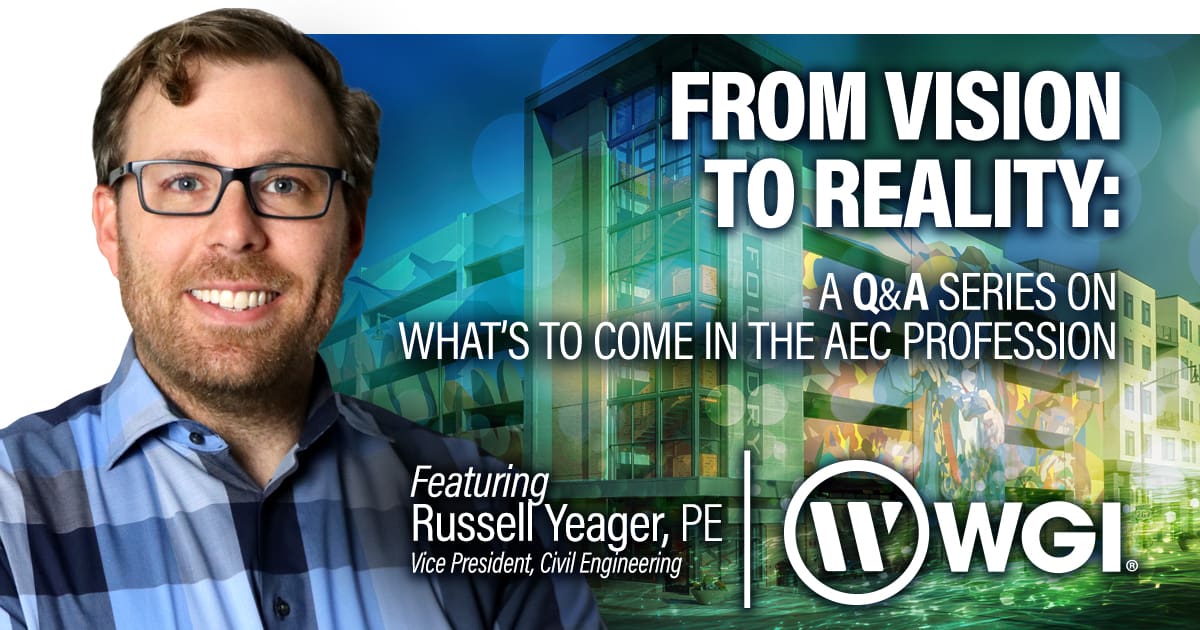
In this edition of From Vision to Reality, we highlight Russell Yeager, PE, Vice President of Civil Engineering, whose insight and leadership play a central role in guiding WGI’s response to today’s most pressing civil engineering challenges.
With more than a decade of experience shaping development throughout Texas, Russell serves as both strategist and steward, aligning technical excellence with thoughtful communication to advance projects that support long-term community and economic vitality. Whether navigating the complexities of water, sewer, and drainage systems, steering multifaceted permitting processes, or forging consensus among diverse municipal and public stakeholders, Russell has built a reputation for delivering clarity, confidence, and a forward-looking perspective.
1. What is your outlook on the current state of the AEC profession?
Shifting demands and evolving priorities across both public and private markets are driving considerable structural transformation within the industry. Projects are increasing in scale and complexity, requiring extensive collaboration and the strategic alignment of resources to successfully integrate private investment with essential infrastructure needs.
In this environment, success hinges on having a team equipped with diverse expertise, the ability to foster strong partnerships with public and private stakeholders, and the capacity to leverage technology to rapidly and effectively address emerging challenges. WGI is proactively strengthening these capabilities by cross-training our widespread team, ensuring that we can swiftly deploy skilled professionals across the nation and consistently deliver exceptional service, regardless of client need.
2. What changes do you see in the AEC profession, and how do these changes present new challenges or opportunities?
Automation in design is only beginning to influence our industry, yet it is rapidly shaping the next generation of work. With a persistent talent gap affecting engineering disciplines, we must maximize the capabilities of every new team member through thoughtful training and development. WGI is well-positioned to lead through this shift, leveraging automation to accelerate project delivery while maintaining the critical oversight and expertise that ensure our work reflects the depth of experience our clients rely on.
As automation becomes more integrated into the AEC landscape, the way we design, visualize, and assess project success will continue to evolve. The transition from traditional two-dimensional plans to fully realized three-dimensional models is now essential. WGI has already embraced this transformation, positioning our teams and clients to benefit from more accurate, efficient, and insightful project outcomes
3. What unique opportunities does your division anticipate through the remainder of 2025 and as we look ahead to 2026?
As we look ahead to 2026, the market presents a uniquely dynamic outlook. Ongoing instability in both the private and public sectors is driving shifts that the industry has yet to fully reconcile, even as national and global expectations continue to rise. This environment offers a distinctive opportunity to deliver innovative, wide-ranging solutions capable of adapting quickly to an evolving landscape.
I remain energized by the prospect of tackling complex projects that unite expertise and resources from across the industry to achieve transformative outcomes. Whether it involves forging creative public partnerships to support major employers seeking new locations or delivering essential infrastructure that enhances everyday life for communities, I look forward to embracing these challenges in 2026 and helping shape meaningful, lasting impact.
4. What unique challenges does your division anticipate through the remainder of 2025 and as we look ahead to 2026?
The AEC landscape continues to face a significant talent shortage, as the number of new graduates entering the field lags behind the rate of retirements. For WGI, aligning our workforce planning with the evolving needs of our clients and communities is essential to ensuring we can solve both today’s challenges and those on the horizon. Our retiring leaders bring invaluable experience, leadership, communication, technical expertise, and a deep understanding of community needs that must be intentionally passed on to the next generation.
We are proud to partner with universities near our offices to help cultivate the next generation of engineering leaders. Our goal is to strengthen our teams at all levels by recruiting seasoned professionals who are passionate about mentoring emerging talent, and by welcoming ambitious young engineers who can harness advanced technologies within the framework of WGI’s institutional knowledge. Together, this balance of experience and innovation ensures that WGI remains well equipped to meet the demands of tomorrow, today.
5. How does collaboration across WGI’s multidisciplinary teams enhance your division’s ability to address industry challenges?
Identifying creative, talented engineers within our existing teams and empowering them to contribute their strengths to our most complex challenges significantly elevates both the pace and the quality of project delivery. Ensuring that every project team is aligned in values, expectations, and goals is essential for effective coordination and consistently successful outcomes.
At WGI, our teams collaborate seamlessly across technical disciplines, providing cross-training and fostering a culture of shared expertise to better serve our clients. For example, by integrating the capabilities of our Structural Engineering and MEP teams, we recently delivered both traditional PDF construction documents and a fully developed digital twin model for a major industrial client. This multidisciplinary approach enabled accelerated construction timelines and provided the end user with an advanced operations and maintenance platform built on the latest available technology.
6. How is WGI leveraging innovation to maintain its leadership position in the AEC profession?
Innovation is deeply embedded in WGI’s culture. We are committed to ensuring every team member’s ideas are heard, thoughtfully evaluated, and, when their potential is clear, implemented in ways that deliver meaningful value.
One of the most exciting examples of this commitment is our continued partnership with Streamline Technologies, which is enabling us to bring real-time data and advanced analytics to the flood management space. While floodplains themselves are not new, the methods traditionally used to manage them are outdated, often relying on static models and limited real-time insight. By integrating real-time predictive modeling, we can dramatically enhance the effectiveness of flood response efforts, empowering first responders with timely, data-driven information that helps reduce loss of life and minimize damage to critical infrastructure.
7. What lessons from recent projects will guide your approach through the remainder of 2025 and as we look ahead to 2026?
Broad engagement with key stakeholders has been essential in delivering projects that create true win-win outcomes for our communities. By leveraging advanced technology, fostering strong relationships, and drawing on WGI’s extensive depth of technical expertise, we are able to fully maximize every opportunity and drive meaningful, lasting results.
Join the Conversation
As the AEC landscape continues to evolve, one thing remains certain: we are stepping into a moment filled with both tremendous opportunity and heightened responsibility. Rapid shifts in technology, market conditions, and workforce expectations are reshaping how firms must operate, pushing us to be more adaptive, more collaborative, and more forward-thinking than ever before.
Russel’s perspective highlights how WGI is channeling this momentum, cultivating emerging leaders, strengthening collaboration across disciplines, and embedding automation and advanced modeling into our daily practice. Navigating what lies ahead will require more than technical expertise; it will demand the ability to unite stakeholders, foster alignment, and guide communities toward a shared and sustainable vision. Backed by the depth and diversity of our multidisciplinary teams, WGI is well-positioned to deliver solutions that meet today’s challenges while anticipating tomorrow’s needs, continuously elevating the standard for what our industry can achieve.
Stay tuned for future editions as we highlight more voices shaping the communities of tomorrow, today – Contact our team today to continue the conversation and learn how the experts at WGI can help turn your vision into reality!