
As infrastructure investment accelerates and demand grows for more technically complex, high-performance facilities, the AEC industry is entering a period defined not just by growth, but by specialization, integration, and innovation. Projects are becoming more sophisticated, timelines more compressed, and expectations higher across every phase of delivery.
At the same time, advances in digital capability, from AI-enabled design workflows to data-driven engineering, are redefining what is possible. Firms that can combine deep technical expertise with meaningful investment in technology and talent are separating themselves in an increasingly competitive landscape.
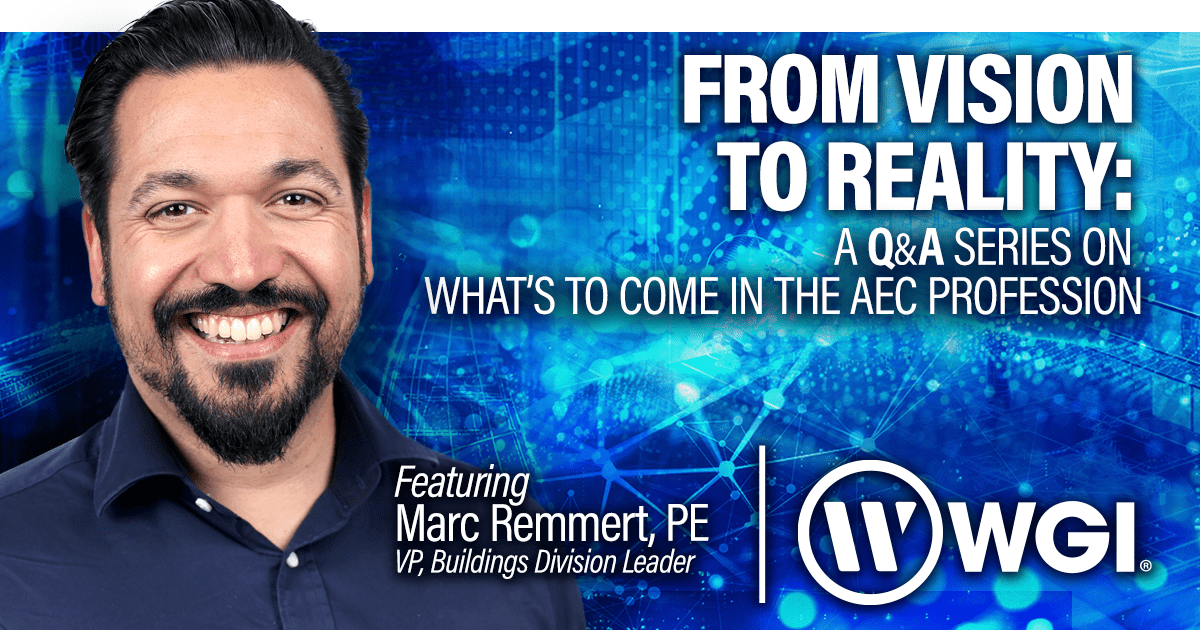
In this edition of From Vision to Reality, we sit down with Marc Remmert, PE, WGI’s Vice President and Buildings Division Leader, to explore how increasing project complexity is reshaping the industry, why technical depth is becoming a defining competitive advantage, and how WGI is positioning itself at the forefront of innovation in the built environment.
Marc shares his perspective on the opportunities emerging across energy infrastructure, advanced manufacturing, and mission-critical facilities, as well as the leadership, talent development, and technology investments required to deliver at the highest level.
1. What is your outlook on the current state of the AEC profession? How do you see the AEC industry evolving in the next 12–24 months, and what role do you think WGI will play in shaping that future?
We’re living through one of the most exciting periods in the history of the AEC profession. The convergence of unprecedented infrastructure investment, rapid advances in design and delivery technology, and growing demand for complex, technically sophisticated projects means that talented engineers and designers have more opportunity to do meaningful, high-impact work than at any point in my career.
What makes this moment especially compelling at WGI is that we’re not waiting to see how the industry evolves. We’re actively shaping it. Our growth across a broad range of disciplines and market sectors means we can offer clients integrated solutions that few firms can match, and it means our people get to work on a breadth of project types that keeps the work genuinely engaging. I believe the next 12 to 24 months will reward firms that have invested in both technical depth and digital capability, and WGI has been building both deliberately.
2. What changes do you see in the AEC profession, and how do these changes present new challenges or opportunities?
The most significant shift I see is the acceleration of what I’d call “the complexity premium.” Clients increasingly need partners who can navigate technically demanding projects that generalist firms simply can’t execute well. Energy infrastructure, advanced manufacturing, data centers, and mission-critical facilities all require genuine depth across the full spectrum of design and engineering disciplines. That is exactly the kind of expertise WGI has spent years building.
At the same time, technology is creating a genuine competitive divide. Firms that are developing real internal capability, not just licensing off-the-shelf tools, are pulling ahead in the quality and sophistication of what they can deliver. For engineers and designers who want to be at the forefront of both technical practice and innovation, this is an extraordinary time to be at a firm like WGI.
3. What are the unique opportunities that your department/division will face through the remainder of the year and as we look ahead to 2026?
We sit at the intersection of several of the most dynamic growth sectors in the built environment right now. Energy transition infrastructure, battery storage systems, EV charging networks, microgrids, and the complex power systems that connect them, is an area where our depth in electrical and power engineering creates a genuine edge. These are not projects you can staff with generalists. They demand engineers and architects who understand highly technical systems at a deep level and can translate that expertise into designs that actually get built.
Advanced manufacturing and mission-critical facilities represent similar opportunities, driven by reshoring momentum and the explosive growth of data centers, and they draw on the full range of our structural, architectural, and engineering capabilities. What I’m most energized by is how we are using technology to raise the ceiling on what our people can conceive and deliver. That is the kind of environment where the best technical talent wants to build a career.
4. What unique challenges does your division anticipate through the remainder of the year and as we look ahead to 2026?
The most meaningful challenge we face, and it is a good problem to have, is that our growth ambitions outpace the supply of people who are ready to step into the kinds of roles we are creating. The demand for engineers, architects, and technical leaders who can drive complex, sophisticated projects in energy, infrastructure, and advanced facilities is greater than what the traditional talent pipeline produces. That is exactly why we invest so deliberately in developing our people: structured mentorship, leadership programming, and project exposure that accelerates careers in ways that are genuinely difficult to replicate elsewhere.
Technology plays a role here too, not by replacing judgment but by expanding what our people are capable of producing. When great engineers are supported by tools that match the quality of their thinking, the work they can do is genuinely exceptional. Growth also brings integration challenges, and we take those seriously. When we bring a team into WGI, we are committed to preserving what made them exceptional while giving them access to a platform that expands what they can accomplish.
5. How does collaboration across WGI’s multidisciplinary teams enhance your division’s ability to address industry challenges?
Our multidisciplinary structure is not just an organizational chart feature. It fundamentally changes the quality of work we can deliver and the experience our people have doing it. When an architect is working alongside structural engineers, power systems specialists, civil engineers, and geospatial professionals on a complex project, the problem-solving is richer and the outcomes are better. The work is also more interesting. On energy infrastructure and mission-critical projects, having that breadth of expertise in the same firm means issues get resolved through genuine collaboration rather than coordination overhead, and clients see that in design quality and project outcomes.
For our people, it means you are never working in a silo. You are part of a team that draws on deep expertise across disciplines, which accelerates learning and opens doors to project opportunities that a single-discipline firm could never offer. The best people I’ve hired tell me that is exactly what they were looking for.
6. How is WGI leveraging innovation to maintain its leadership position in the AEC profession?
At WGI, innovation is a leadership priority, not a committee or a tagline. I carry the firm’s innovation mandate as part of my executive role, and I lead a dedicated team of engineers and software developers who are working on what the future of technical practice actually looks like. The work we are doing with AI is not about doing the same things faster. It is about changing what is possible.
When AI is woven into design workflows and technical analysis, it expands the range of options an engineer or architect can explore, elevates the rigor of the decisions they make, and raises the quality of what gets delivered. The goal is to make great engineers capable of even greater work. For people who want to be at the forefront of that shift, not just benefiting from it but actively building it, this is a rare environment. We are developing things that do not exist yet, inside a firm with the scale and technical diversity to put those capabilities to work immediately.
7. What lessons from recent projects will guide your approach through the remainder of the year and as we look ahead to 2026?
The clearest lesson is that doing the hardest projects well requires intentional investment in both technical capability and the culture that supports it, and that investment compounds over time. The work we have taken on in energy infrastructure, mission-critical facilities, and technically complex building programs has sharpened our team in ways that attract more ambitious work. That is the kind of upward cycle that makes a firm genuinely exciting to be part of.
I have also been reminded, again and again, that the relationships clients value most are the ones built on consistent delivery and real technical partnership. When our teams bring that to a project, clients come back with more work and introduce us to others. That is the growth engine that matters most. And on the people side, the investment we have made in leadership development and mentorship this year means WGI’s strength is in the depth of the team, not concentrated in any one person or group. That is what makes a firm built to last.
Join the Conversation
The AEC industry is evolving into a landscape where complexity is the standard, not the exception. As projects demand deeper technical expertise, greater integration across disciplines, and more advanced digital capabilities, firms must be intentional about how they invest in both people and innovation.
Marc’s insights highlight a clear reality: sustainable growth is not just about expanding capacity, but about elevating capability. From developing the next generation of technical leaders to embedding AI into design workflows, the firms that lead will be those that continuously raise the ceiling on what their teams can deliver.
Equally important is the ability to maintain culture and collaboration at scale. As organizations grow, preserving what makes teams exceptional while expanding their reach becomes a critical differentiator.
As we look toward 2026 and beyond, success in the AEC profession will be defined by those who can combine technical depth, digital advancement, and strong leadership into a unified platform for delivery.
Stay tuned for more insights from the leaders shaping WGI’s future in upcoming editions of From Vision to Reality.