

Delivering a new building or infrastructure project today is complex. Timelines are tight. Budgets are scrutinized. Expectations are high. And often, a small Owner team (or even a single representative) is responsible for getting it done, usually while managing other priorities.
Most Owners know to focus on assembling the right technical team. That matters. But at WGI, we believe the more consequential decision happens earlier: the team’s structure. And, more specifically, that choosing a Prime delivery model will significantly influence risk exposure, cost control, and whether project intent survives from concept through construction.
A Prime delivery model will significantly influence risk exposure, cost control, and whether project intent survives from concept through construction.
What is Prime?
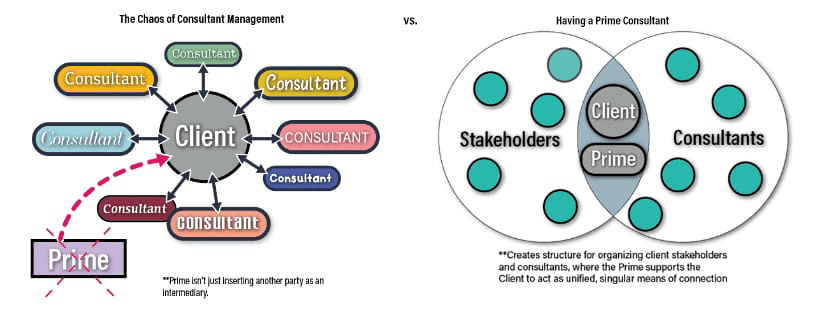
A Prime delivery model means contracting a single entity responsible for sourcing, directing, and integrating all professional design services on a project. Instead of managing multiple independent consultant relationships, the Owner works through one accountable point of integration. On a typical development project, a dozen or more disciplines may be involved. Even just administratively, that consolidation is impactful.
But the real value lies much deeper. Importantly, a Prime is not simply an intermediary layer inserted into the existing owner–consultant setup. It reshapes the structure entirely—consolidating what would otherwise be fragmented lines of responsibility into one accountable point of integration and creating a unified flow of information, coordination, decision-making, and design oversight across all disciplines.
Think about it like this: Have you ever been to a potluck where there were three of the same side dish, but no real main course? One person showed up with a bag of Oreos, another spent hours baking an entire cake. The buffalo dip was gone in ten minutes, but there were still five unopened bags of tortilla chips sitting on the counter. The charcuterie board rolled in three hours late. No one did anything “wrong”, but no one was responsible for the whole.
Now think about the best party planner you know. They share the tone and theme of an event upfront. They guide people on what dishes to bring and keep track of who’s bringing what. They remember dietary restrictions and calculate how much food will actually be needed to feed everyone. They make sure the hot dishes can stay hot. They are like a Prime: managing dependencies, balancing contributions, and ensuring the whole thing comes together intentionally rather than accidentally.
Prime: The Owner’s Translator, Orchestrator & Advocate
In the same way a great planner understands their guests and event, the Prime works across the full spectrum of stakeholders and technical disciplines.
Owners rarely operate as a single voice. Requirements come from across the business (think Operations, Finance, IT, Safety, Marketing, Legal…), often at different times and with competing priorities. A Prime doesn’t simply pass that information along; they identify who needs to be involved, surface internal misalignments, and consolidate direction, before something piecemeal becomes embedded in drawings.
Owners rarely operate as a single voice. Requirements come from across the business, often at different times and with competing priorities.
In tandem, they ensure each discipline receives clear, consistent inputs, so engineers and designers aren’t building solutions based on partial or evolving assumptions. The Prime manages both sides of the equation: aligning the Owner internally and translating that into actionable technical direction.
Most consultants are optimized to operate within their own discipline, so translation alone isn’t enough. Someone must merge those parallel efforts into a cohesive whole. This is where the Prime’s cross-disciplinary expertise becomes essential. They understand how structural decisions affect MEP systems, how operational requirements influence architectural layouts, how a shift in scope can ripple across schedules. They’re not simply relaying information; they’re synthesizing it.
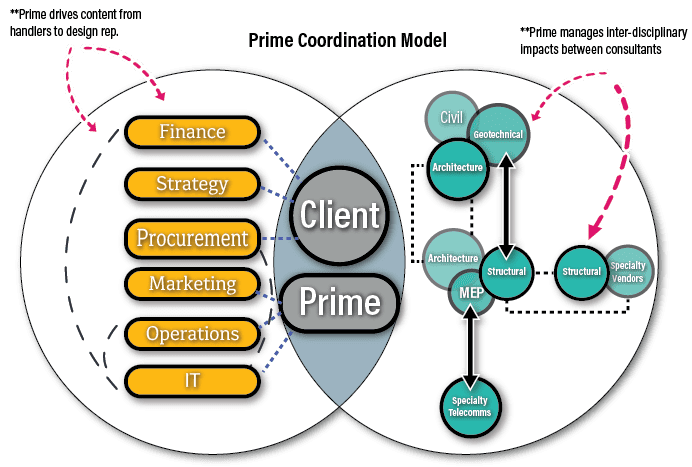
Without this, Owners often find themselves mediating between parallel streams of consultants, often without full visibility into the technical consequences. And when issues inevitably surface, determining responsibility and coordinating resolution can drain time and momentum. The Prime orchestrates this integration, so conflicts are surfaced earlier, tradeoffs are evaluated strategically, and technical decisions are tested, before they reach the field.
This Integration isn’t a one-time exercise. It extends across the entire lifecycle of a project. As design advances and constraints evolve, dozens of incremental decisions accumulate. Each may make sense in isolation. Over time, however, those small adjustments can quietly erode the original intent, altering performance, scope, cost, or experience in ways that aren’t obvious in the moment.
The Prime maintains that holistic perspective. They continuously pressure-test decisions against the Owner’s objectives, asking:
not just “Does this work technically?” but “Does it achieve what we set out to build?”
Without someone holding that lens, Owners often discover drift much later. That timing matters. Because the later a misalignment or conflict is discovered, the more expensive it becomes to resolve.
The Real Cost of Prime Delivery
At this point, an Owner might reasonably be thinking: This sounds valuable—but can I afford this additional level of focus and integration?

Consider this: a Construction Industry Institute (CII) study found that deviations resulting in rework average 12.4% of total installed project cost, with design changes, errors, and omissions responsible for approximately 79% of deviation costs. In practical terms, roughly 10% of total project cost on an average project is tied to design-related construction changes.
Prime delivery is not a magic wand that eliminates change. Its value lies in identifying underlying misalignments, scope gaps, and discipline conflicts earlier in the process—when options are broader, costs are still manageable, and tradeoffs can be chosen deliberately.
So the real question isn’t “Can I afford a Prime?”, it’s “How much will it cost me not to have one?”
Contact Us
At WGI, we can deliver Prime services in many ways. If you’re preparing to launch a new project or evaluating how to best structure your team, WGI’s Prime delivery experts can help assess what model best aligns with your goals and resources. Reach out to WGI to start the conversation and set your project up for success from day one.