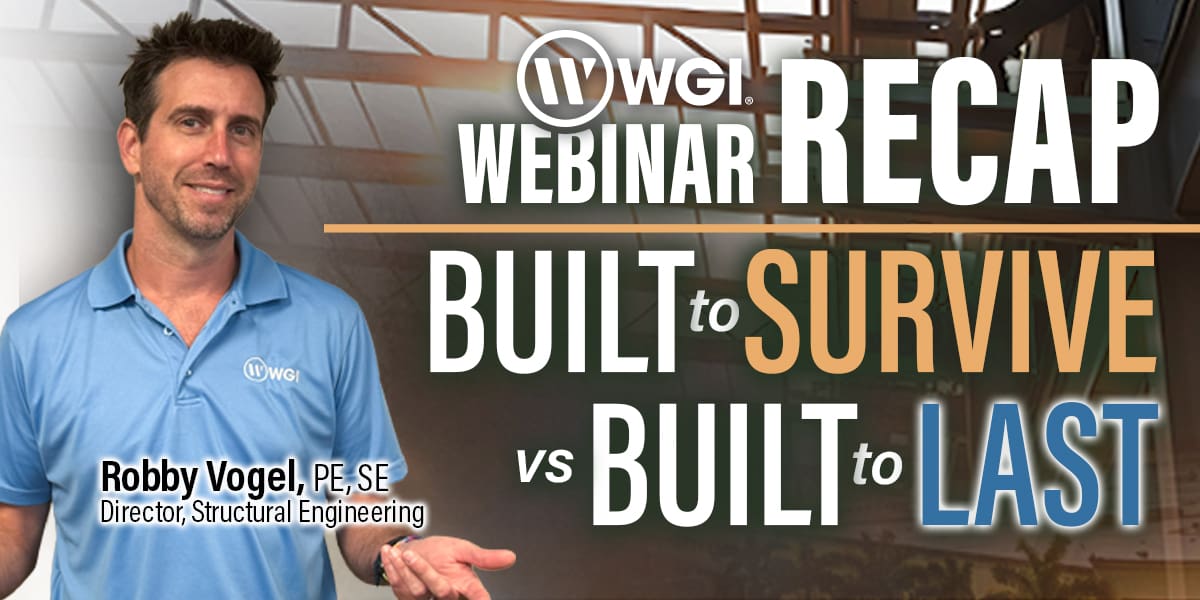
In our latest webinar, Built to Survive vs. Built to Last, WGI’s Director of Structural Engineering, Robby Vogel, PE, SE, explored the gap between building code compliance and operational continuity and the design decisions that determine whether a facility merely survives a major wind event or actually performs after one.
As hurricanes reach further inland and the tornado corridor shifts eastward, facilities across Florida, Texas, and the Carolinas face compounding wind hazards over a single building’s life. At the same time, the building code, by design, was never written to keep a 911 center or emergency operations center running the week after a storm. That gap between life safety and operational continuity is where storm recovery is decided, and it is determined long before the clouds arrive.
WGI’s integrated engineering approach brings structural, MEP, civil, and architectural disciplines together early in the design process to address exactly this challenge. The decisions that govern how a facility responds to extreme wind loading like load path continuity, envelope performance, backup power, communications redundancy, and site access, are most efficiently made during initial design. When they are deferred, they return later as retrofit projects at significantly higher cost, or not at all.
Key Takeaways from this Webinar Include
- Why code-compliant buildings can still fail operationally, and the four gaps WGI finds consistently when assessing existing facilities
- How passive resilience strategies (structural load paths, impact-rated openings, site grading) must be built in from day one, and how active strategies (generators, redundant communications, continuity of operations plans) operate within the limits passive design establishes.
- What Risk Category IV actually guarantees under ASCE 7 and the IBC, and what it leaves entirely to the owner’s discretion.
- How the insurance market in high-risk coastal regions is shifting toward demonstrated performance rather than assumed compliance, and how to build the total cost of ownership case for resilience investment before a storm forces it.
- Real outcomes from Edwardsville, Illinois; Spartanburg County, South Carolina; Palm Beach County, Florida; and the Escambia–Santa Rosa Regional Traffic Management Center in Pensacola.
- And So. Much. More.
Whether you’re a facility owner, capital planner, county engineer, or public-sector leader responsible for infrastructure in hurricane or tornado country, understanding the difference between compliance and continuity is essential to protecting the functions your community depends on when conditions are at their worst.
Watch the Full Recap
If you missed our live session or want to revisit the discussion, click below to watch the full webinar recording and explore our companion whitepaper for deeper insights into the engineering framework behind storm-ready facility design.
Explore the Full Report
Download our whitepaper, “Built to Survive vs. Built to Last,” for the complete framework WGI uses to translate “must remain operational” into design decisions across structural, MEP, civil, and architecture, including passive vs. active strategy sequencing, facility case studies, and total cost of ownership math.
Connect With Our Experts
If your organization owns, operates, or designs facilities that cannot afford to go dark when conditions are at their worst, WGI’s integrated engineering teams can help you define what your facilities need to do and align design decisions accordingly.
Connect with our team today to learn how WGI can help your organization close the gap between compliance and continuity.