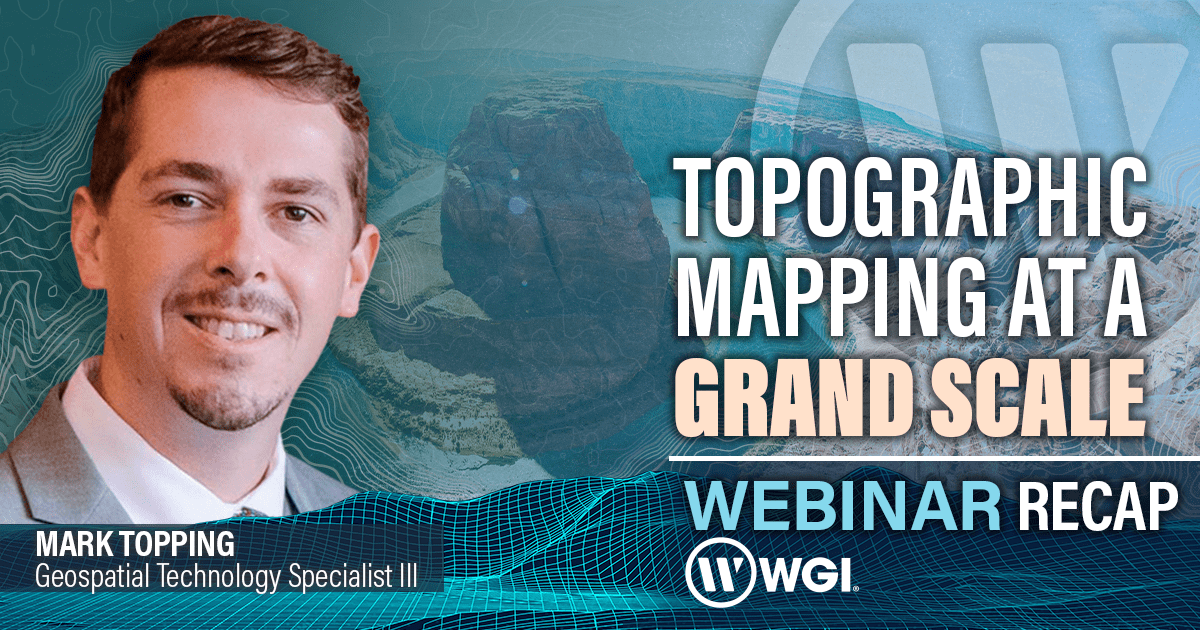
Webinar Recap: Topographic Mapping at a Grand Scale

From the region-specific challenges to airspace access and ecological considerations, join WGI’s Geospatial Technology Specialist III, Mark Topping, for an exclusive look into the in-depth planning and cutting-edge technologies that were instrumental in crafting the highest-resolutions dataset for one of the natural wonders of the world.

In the most recent installment of our Webinar Series, Mark Topping, WGI’s Geospatial Technology Specialist III, took viewers on an enlightening journey through the intricacies of topographic mapping using lidar technology, with a special focus on a monumental project: the mapping of the Grand Canyon National Park.

Elevation data is a cornerstone of informed decision-making across various sectors, from public to private and academia. While substantial progress has been made in collecting high-resolution elevation models using airborne lidar technology, the unique diversity of the United States’ landscape demands even higher-resolution data for emerging applications like hydrography.

WGI Geospatial, a leading provider of geospatial data acquisition and processing, showcased the value of a customized project planning approach through the lens of a challenging endeavor: mapping over 800 square miles of the iconic Grand Canyon.

Throughout this webinar, attendees gained insights into the intricacies of this massive mapping project, including the specific requirements and deliverables expected for a standard federal project intended for public consumption. By delving into these challenges, Mark illuminated the critical role of comprehensive project planning in the successful execution of large-scale mapping endeavors. The webinar not only underscored the technical aspects of lidar-derived mapping but also emphasized the importance of understanding and navigating the unique complexities inherent in projects of this magnitude.
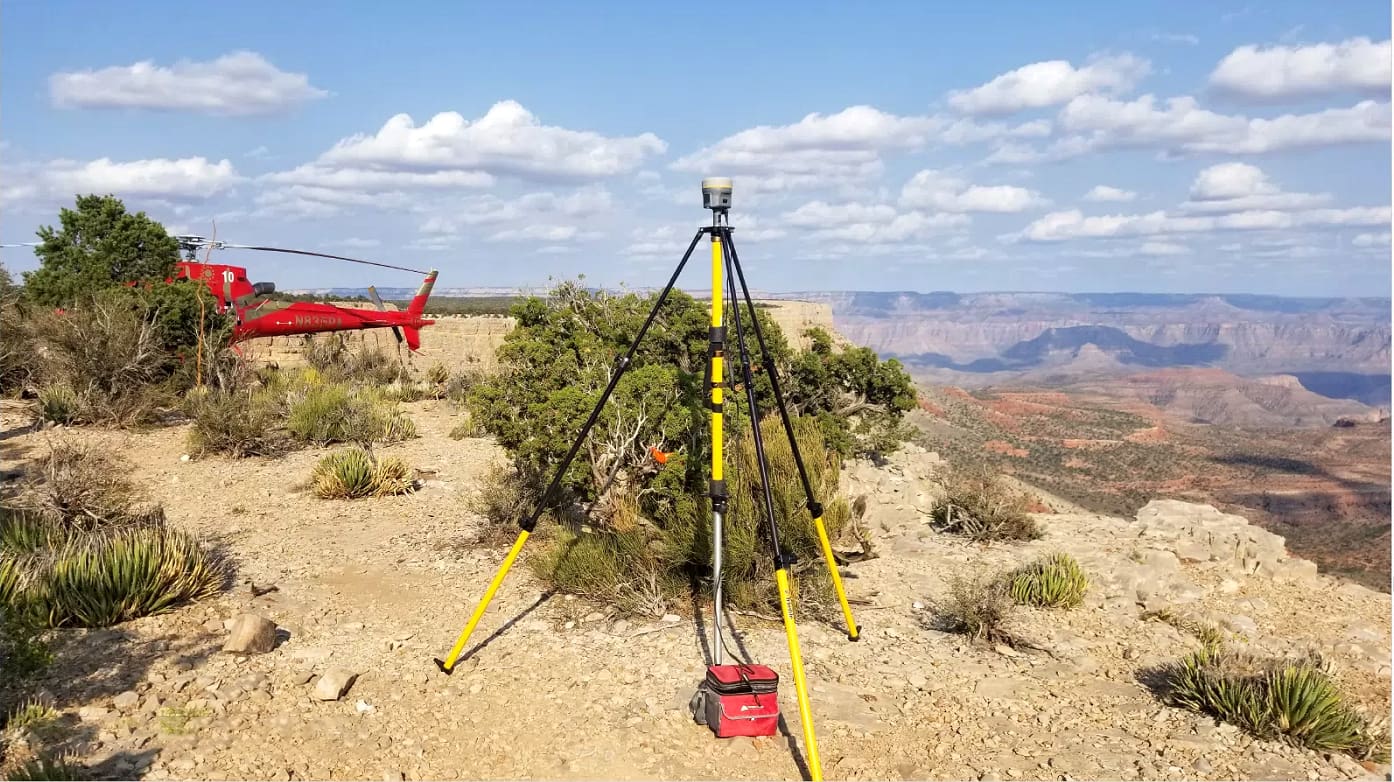
grand canyon

At WGI, our Mission is Simple: to empower you with the ability to choose the optimal tool for each and every project – Whether it’s FWAL, TML, UAS, or traditional survey methods, we have the expertise & resources to provide you with the ideal solution to meet any need.

If you were unable to attend our live webinar or are curious about how our experts can deploy our state-of-the-art technology for your next project, check out a full video recap of the webinar session and gain a better understanding of the following:

  • Advantages and limitations of airborne, topographic lidar technology
  • Lidar derivatives and standards of a federal lidar project
  • Critical upfront considerations for a large-scale mapping project
  • Approaches for solving region-specific challenges

Are you interested in unlocking access to exclusive case studies and exploring the cutting-edge lidar technologies used while mapping the Grand Canyon, which are now shaping the future of survey and mapping activities across the nation?

Check out another FREE resource for a wealth of information on this groundbreaking project:

Contact WGI’s Geospatial + Land Surveying professionals today to ensure unmatched accuracy and efficiency – We’re standing by to discuss how WGI’s innovative solutions can be applied to your next project to make it a GRAND one!

Share this post

Share this post

Learn more
about our
services

Related

Webinar

Webinar Recap: Built to Survive vs Built to Last

Join Robby Vogel, PE, SE as he explores the gap between building code compliance and operational continuity, and the structural, envelope, and systems decisions that determine whether a facility performs when a major storm hits.

Blog

Project Spotlight: 3550 South Ocean Boulevard

Discover how WGI helped bring 3550 South Ocean to life, delivering integrated civil engineering and landscape architecture services for Palm Beach Island’s first new oceanfront condominium development in more than a decade.

Blog

The Future of Policy Code Updates and Municipal Planning

Municipal planning is evolving through more precise, data-driven applications of policy, code, and technology. This blog explores how communities are refining their approaches to stay adaptable, align with infrastructure realities, and guide growth with greater clarity and confidence.

Blog

Wetlands in Balance: Navigating Florida’s Freshwater Wetlands and Canal Systems

Florida’s freshwater wetlands and canal systems are among the state’s most important, and complex, natural and water resources. Explore how WGI helps clients navigate evolving regulations, multi-agency permitting requirements, protected species considerations, and environmental constraints to support successful project delivery while protecting Florida’s interconnected water resources.

JOIN THE TEAM

You’ve been searching for a place like WGI. We look forward to meeting you soon.

We're
Nearby

Enter your zip code, and we’ll personalize your experience with local projects, office locations, team members, and more.

WGI's success starts with our Associates

WGI supports its associates with meaningful opportunities for growth, strong benefits and perks, while we work collaboratively with clients and co-consultants to shape and improve communities.

Our Team in Action

Join the Team

WGI is a dynamic organization with opportunities nationwide for engineers, land surveyors, landscape architects, environmental scientists, and architects.

Find a team member:

Let's talk about your next project.