.png?width=185&height=175&name=WGI%20Icon_Green%20(1).png)


















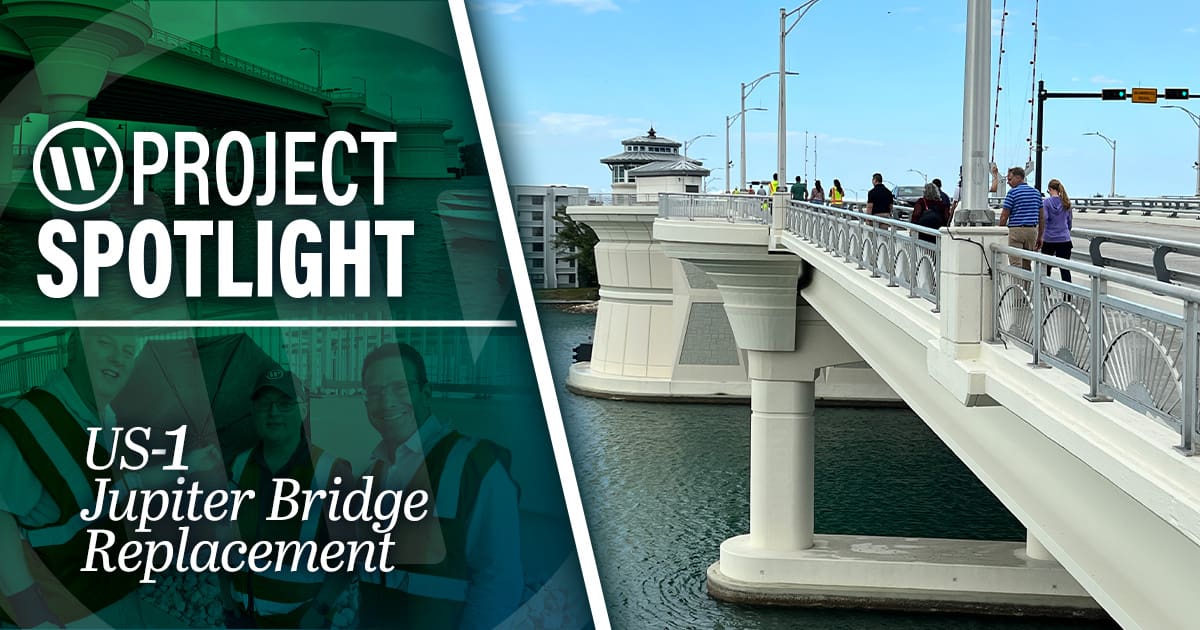
Along Florida’s treasured coastline in Jupiter, the US-1 corridor serves as a vital link for residents, businesses, and visitors traveling across the Loxahatchee River and Intracoastal Waterway. For decades, the original 1958 bascule bridge carried traffic through the heart of the community. However, as population growth intensified and mobility demands increased, the aging structure no longer met modern standards for safety, capacity, or navigation clearance.
The Florida Department of Transportation (FDOT) launched the US-1 Jupiter Bridge Replacement project to deliver a long-term solution, one that enhances vehicular flow, improves marine navigation, and creates safer accommodations for cyclists and pedestrians.
WGI was proud to support this transformative infrastructure investment as a subconsultant, delivering coordinated, multidisciplinary solutions that strengthened mobility and long-term performance along the US-1 corridor.
 Maintaining mobility during construction was a top priority. A phased construction approach allowed traffic to remain operational on half of the bridge while the other half was rebuilt, minimizing disruption along one of the region’s most important north-south corridors.
 Drainage Engineering
Given the project’s coastal setting, effective stormwater management was essential. WGI designed drainage systems that meet FDOT standards while addressing environmental considerations near the Loxahatchee River and surrounding waterways.
Utility Coordination
Utility conflicts are common in corridor reconstruction projects of this scale. WGI coordinated closely with providers to identify, relocate, and protect critical infrastructure, minimizing construction delays and ensuring continuity of service.
Survey & Subsurface Utility Engineering (SUE)
Accurate data was fundamental to the project’s success. WGI’s survey and SUE teams provided detailed mapping of existing conditions and underground utilities, reducing risk and supporting informed design decisions.
Sensitive Structure Monitoring
Given the bridge’s proximity to historic and community landmarks, monitoring efforts were implemented during critical construction activities to safeguard nearby structures while foundation work and pier installation progressed.
Extensive coordination was also required to tie improvements into adjacent residential communities, including the entrances to Jupiter Cove and Jupiter Harbour, ensuring smooth transitions and continued accessibility.
Drainage Engineering
Given the project’s coastal setting, effective stormwater management was essential. WGI designed drainage systems that meet FDOT standards while addressing environmental considerations near the Loxahatchee River and surrounding waterways.
Utility Coordination
Utility conflicts are common in corridor reconstruction projects of this scale. WGI coordinated closely with providers to identify, relocate, and protect critical infrastructure, minimizing construction delays and ensuring continuity of service.
Survey & Subsurface Utility Engineering (SUE)
Accurate data was fundamental to the project’s success. WGI’s survey and SUE teams provided detailed mapping of existing conditions and underground utilities, reducing risk and supporting informed design decisions.
Sensitive Structure Monitoring
Given the bridge’s proximity to historic and community landmarks, monitoring efforts were implemented during critical construction activities to safeguard nearby structures while foundation work and pier installation progressed.
Extensive coordination was also required to tie improvements into adjacent residential communities, including the entrances to Jupiter Cove and Jupiter Harbour, ensuring smooth transitions and continued accessibility.
 Beyond the structure itself, the project reflects the value of comprehensive planning, phased construction strategy, and multidisciplinary coordination. By addressing roadway approaches, detour routing, utilities, and drainage systems holistically, the project team delivered infrastructure designed to serve Jupiter for generations.
WGI is proud to have contributed to a project that strengthens connectivity across Palm Beach County while reinforcing the resilience of one of Florida’s most essential coastal corridors.
Beyond the structure itself, the project reflects the value of comprehensive planning, phased construction strategy, and multidisciplinary coordination. By addressing roadway approaches, detour routing, utilities, and drainage systems holistically, the project team delivered infrastructure designed to serve Jupiter for generations.
WGI is proud to have contributed to a project that strengthens connectivity across Palm Beach County while reinforcing the resilience of one of Florida’s most essential coastal corridors.
Replacing a Critical Coastal Crossing
Officially identified as SR 5/US 1 from SR A1A/Ocean Boulevard to Beach Road in Palm Beach County, the project involved replacing the existing four-lane low-level bascule bridge with a new mid-level twin double-leaf bascule structure constructed along the same alignment. The new bridge significantly increases vertical clearance, reducing the frequency of bridge openings and improving traffic continuity for motorists while enhancing passage for marine vessels below. The upgraded structure features:- Two travel lanes in each direction
- Dedicated seven-foot bicycle lanes
- Eight-foot sidewalks on both sides
- Permanent traffic railings separating pedestrians and cyclists from vehicular travel

Planning Beyond the Bridge: Detours and Intersection Improvements
The project extended well beyond the main span. During a full bridge closure period, FDOT required a comprehensive 20-month temporary detour plan to maintain acceptable levels of service and ensure safety along alternate routes. WGI supported the development of conceptual and temporary alignment solutions at several critical intersections, including:- SR 706 (Indiantown Road) at SR 811 (Alt. A1A)
- US 1 at SR 706
- US 1 at Beach Road
WGI’s Role: Integrated Infrastructure Expertise
As part of the project team, WGI delivered specialized technical services that supported both the bridge replacement and associated roadway improvements. Roadway Design WGI developed detailed roadway plans for the bridge approaches and detour alignments, ensuring safe geometry, clear lane transitions, and seamless integration with existing infrastructure.
A Stronger, Safer Future for Jupiter
Completed in late 2025, the new US-1 Jupiter Bridge stands as a modern gateway for the community that improves safety, enhances traffic flow, and supports marine navigation while providing dedicated facilities for pedestrians and cyclists.